Showing posts with label White-rumped Shama. Show all posts

Monday, 22 March 2021

From Fish Owl to Gulls

 I visited Cheung Chau the other night and successfully found the Brown Fish Owl at its 'usual' spot along the promenade. As always, it was such a thrill to see this species in the wild, I can never get bored of them. Brown Fish Owl is a widespread species in Hong Kong, you can find them near many streams, as well as water catchments and reservoirs, or in this case the waterfront.


Brown Fish Owl

Many birds in Tai Po Kau are now showing signs of breeding, such as Grey-chinned Minivets which are now getting paired up instead of moving in large flocks. The usually quiet Plain Flowerpeckers are now very vocal and many can be heard throughout the trails.

Grey-chinned Minivet - male
Plain Flowerpecker

I heard the melodious songs of a White-rumped Shama, a species I seldom see at Tai Po Kau. It was behaving in the most classic 'Shama-like' manner, singing loudly in a gully inside the dense forest, it later showed itself briefly. Previously recognised as released or escapes, the number of Shamas reported in Hong Kong the last few years suggests they have now established a small breeding population.


White-rumped Shama

Speckled Piculets can be heard drumming, this one was pecking away near the top of a bare tree, which made it very visible. Another very vocal species at the moment is the Chinese Barbets, where this was a very rare species just a few years back, at least two were calling constantly at Tai Po Kau with several other reported at various sites such as Kadorie Farm, Shing Mun and Tai Lam, the pair at Tai Po Kau seems to be making a nest on a dead tree stump, a good sign that this species is slowly spreading.

Speckled Piculet

Chinese Barbet

A Ring-billed Gull was reported on Saturday at Mai Po, which will be the first ever record for Hong Kong as well as China, unfortunately I had work in the afternoon that day and missed the bird. I tried my luck the next day and ventured out to Deep Bay. The mudflat wasn't particularly interesting, the only notable wader being a Far Eastern Curlew. Many Black-faced Spoonbills now in their breeding plumage, making them even more attractive to look at. Caspian Terns are now in decent numbers.

Far Eastern Curlew


Black-faced Spoonbill

Caspian Tern

Despite not being able to relocate the Ring-billed Gull, there were plenty of other gulls to look at. Large Larus species have always been troublesome group of birds for birders worldwide, the inconsistencies of information of these gulls in Asia have made learning how to differentiate them even more challenging, as taxonomy is being updated every few years. The constant hybridisation of the three (or two) species that occurs in Hong Kong and the physical differences at various age makes identification even more difficult. None the less, gulls are fascinating and well worth spending some time to look into. I can't dare say I am a good 'gull-er', but it is important for birders to keep in mind that gull identification is a constant learning process.

Currently, IOC list that two members of the 'Herring-type' Larus that occurs in Hong Kong are the Vega Gull and Lesser Black-backed Gull. Of which, two subspecies of Vega Gulls are known to occur in Hong Kong, namely vegae vegae and vegae mongolicus. Of these two mongolicus is by far the more common one. Here is a brief update on the large gulls that occurs in Hong Kong.

Vega Gull (mongolicus)

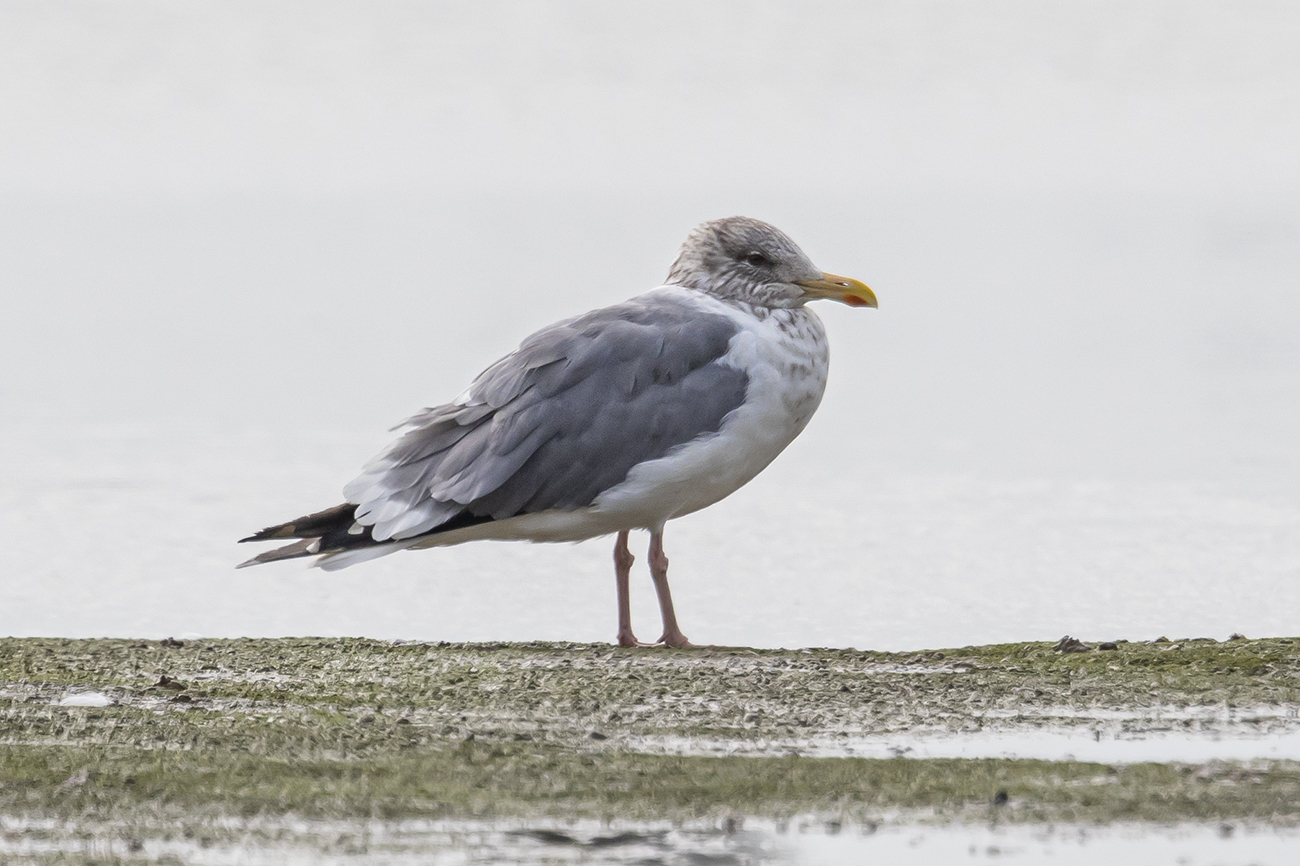
Here is a good example of an adult Vega Gull mongolicus early in the year and in spring, with completely white head, pinkish legs and lighter grey backs. It is important to note that mongolicus moult earlier than the rest due to their breeding grounds being further south. 

Vega Gull (mongolicus) - adult

This below is likely a sub-adult bird showing most of the same features as adult, except for some feathers still retaining on lesser coverts, as well as fine spots on the back of the neck.

Vega Gull (mongolicus) - sub-adult

Likely a 3rd year bird, with very worned out tertiaries, greater and lesser coverts, with 'saddle' developing. Overall structure is that expected of mongolicus, shorter winged than heuglini.

Vega Gull (mongolicus) - 3rd year

Here are a 2nd year bird that shows traits of Vega vegae such as well marked head and neck, although not quite as extensively as one might expect, it is also not quite as blotchy as expected on the flanks or underside. Structurally this feels shorter winged than that of heuglini, so I am leaning towards this being either a vegae or mongolicus, but can't confidently identify these to species level.


2nd  year vegae / mongolicus?

Vega Gull (vegae)

This is the least common of the three 'common' species of large gulls in Hong Kong, adults seen in Hong Kong are usually easily picked up by heavily marked head and breast, as well as pink legs. This is an old photo from Feb 2016.

Vega Gull (vegae) - adult

The individual on the left here I would consider a good candidate as a 3rd year vegae, compared with the heuglini on the right, it looks much chunkier, where as heuglini looks slimmer and more slender. The heavily mottled neck, breast as well as underside is also a good indication for this being a likely vegae.

3rd year vegae (left) and 2nd year heuglini (right)

A very dark looking individual probably a 2nd year vegae, first of all it is very heavily blotched and well marked from head to underside, this is very unlikely to be heuglini or mongolicus. Also note the almost unicolour greater coverts and very thinly patterned scapulars and coverts, giving it an impression of 'light back'. 

Probably two mongolicus (left) and 2nd year vegae (right)

2nd year vegae

Lesser Black-backed Gull (heuglini)

By far our most numerous large gull, local birders usually just refer these as Heuglin's Gulls. adults are easily separable with Vega due to its very dark back, structurally they look more slender and longer winged, leg colour is also a good method to separate them as adult heuglini always have yellow legs. while 2nd and 3rd year birds show similar structure with adults, with darker scapulars and coverts than Vega in general, with a more distinct 'white collar' around the head.

Adult heuglini (left) and 2nd year heuglini (right)

These are the general rule of thumb for 'herring-type' large gulls in Hong Kong at the moment, there are of course a lot of variations and hybridisation are known to exist more often than we would like, therefore it is important to keep in mind that identifying these gulls are sometimes like looking at a spectrum, where you may get traits of both species in one bird, sometimes on more than the other.

Thursday, 21 January 2021

White-spectacled Warbler - Friendly Guy!

Tai Po Kau continues to be one of the better forest sites lately, with big bird waves that you can often enjoy good views of birds for over an hour! The best bird for me was no doubt a beautiful White-spectacled Warbler which was friendly enough to allow for some good photos. These are by far the best photos I've taken of this species, and what a fine looking specimen this was, with textbook broke eye ring and a strong second wing-bar. The Alstrom's Warbler was also present but did not show well enough for a photo.


White-spectacled Warbler

Other quality warblers continuing includes at least two Sulphur-breasted Warblers, which showed fairly well. Hartert's Leaf Warblers were in no short supply and there were plenty of fine looking individuals such as this very yellowish one. I saw at least two Kloss's Leaf Warblers again, although they preferred to stay higher up and seldom come down low for photos.


Sulphur-breasted Warbler

Hartert's Leaf Warbler

Kloss's Leaf Warbler

Other good birds in the bird waves includes Grey-headed Canary Flycatchers, they rarely disappoint and often come down quite low to feed, I can hardly resist taking more photos of this species.


Grey-headed Canary Flycatcher

A single Black Bulbul was seen amongst the numerous Mountain and Chestnut Bulbuls, while other bird wave regulars includes numerous White-bellied Erpornis and Yellow-cheeked Tits at close range.

Black Bulbul

White-bellied Erpornis

Yellow-cheeked Tit - male

Tai Mei Tuk Catchment have been away from the spotlight of late, other than the long staying Grey Bush Chats, I came across a very cooperative Speckled Piculet which drummed at close range. It was in view for over five minutes before moving on. While over at Lam Tsuen a male Verditer Flycatcher showed well late afternoon, it was feeding at the forest edge next to the paddies, hawking for flying insects with a Siberian Stonechat!


Speckled Piculet

Verditer Flycatcher - male

Its been a good winter for Rufous-tailed Robins, where they are very abundant in most wooded areas, I came across a few very vocal individuals, which started singing in the midst of a few warmer winter days. Despite being a common species, I've always found them to be extremely charming.


Rufous-tailed Robin

I gave Yan Yee Road at Sai Kung a try one late morning and yielded a female White-rumped Shama, which seems to be a local specialty there, this species is now locally common in some parts of Sai Kung and often seen at Shing Mun.

White-rumped Shama - female

I encountered only a few small bird waves along the catchment, with a few photogenic Streak-breasted Scimitar Babblers willing to pose for a photo. One of the better find along Yan Yee Road were a few Pale Thrush, which is rather scarce this winter. Finally, I found another Siberian Rubythroat strolling about in the open near the car park, although nowhere as friendly as the one near Tsing Tam Reservoir.

Streak-breasted Scimitar Babble


Pale Thrush


Siberian Rubythroat - male

Monday, 9 April 2018

Change of Wind

Swinhoe's Minivet - one of the migrant getting grounded by the strong northerly wind.

It's all about the wind when you are looking for migrants, during spring when all the birds are moving northwards, south easterly winds with good weather will often result in a lot of migrants flying past Hong Kong without stopping. So, a cold front during these times often result in some good birds being forced to land in order to conserve energy from the strong northerly winds. This was exactly what happened during the weekend.

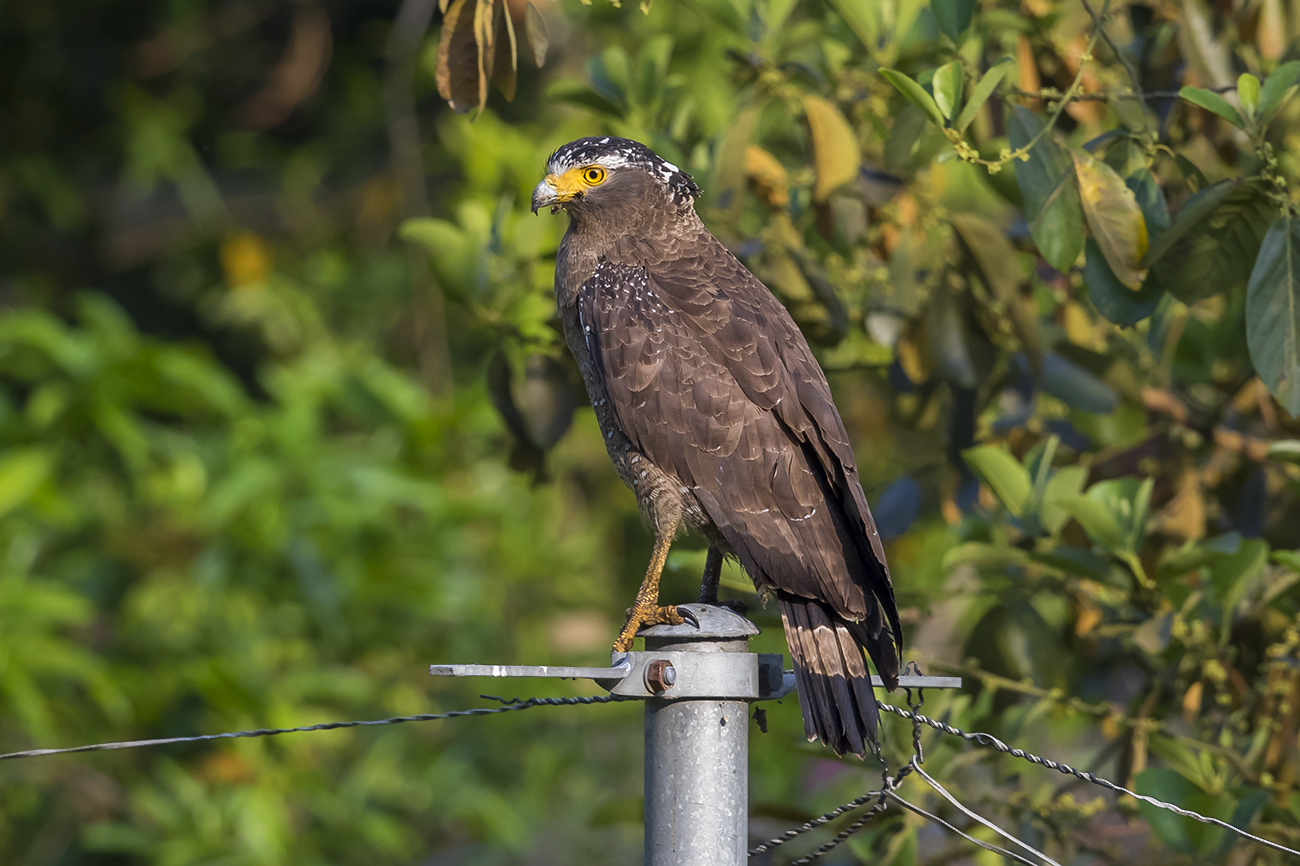
Friday morning I headed to Tai Po Kau with Long in hope for some migrating flycatchers. The weather forecast predicted a cold front to hit Hong Kong that day, although evidently the cold front had yet to arrive, as it was still fairly warm as we walked up the slope. The rather confiding Crested Serpent Eagle was again present early morning, they are simply great looking raptors to see up close.

Crested Serpent Eagle - becoming a regular at Tai Po Kau

The trails were surprisingly quiet, we barely had a bird wave, breeding season could have something to do with this, as birds often disperse and get into pairs to breed and don't form large flocks as they often do in winter. We got two interesting resident species, including a Lesser Shortwing which showed well (by shortwing standared), and a rather confiding Plain Flowerpecker which is still considered to be a fairly rare species in Hong Kong, although I heard up to three birds throughout Tai Po Kau.

Lesser Shortwing - it just need to have a twig in-between...

Plain Flowerpecker

I was surprised to have found only one Hainan Blue Flycatcher in song, I am sure more will arrive very soon. This is easily one of my favourite breeding species in Hong Kong, and likely the most good looking summer visitor.


Hainan Blue Flycatcher - male

On our way back down I heard a melodic song that was not particularly familiar, I thought it could be an Orange-headed Thrush but sounded quite different. The bird in song soon revealed itself to be a male White-rumped Shama! Although we do have one or two records here and there from time to time, they are not thought to naturally occur in Hong Kong, all records have been treated as escaped so far. This bird looked quite good, with no apparent cage damage, although it is possible that an ex-captive individual to have moulted since it's initial release. They are found in Guangxi as well as Hainan, just a few hundred kilometres from Hong Kong, so it's not impossible for us to get wild individuals, although they are such popular caged birds that ex-captive birds seems to be the most logical explanation for their sporadic appearances.


White-rumped Shama - a bit of a surprise

In the afternoon I picked up Hoiling and headed into San Tin hoping to find Oriental Plovers, the cold front had started to move through by then and we experienced very light showers while the northerly wind picked up. We failed to locate anything interesting except for a pair of Osprey looking for fish around some fishponds which allowed fairly close views. We later stopped at Mai Po for a brief visit hoping for any Blue-tailed Bee-eaters dropping in, but again saw none, although we saw the long staying Greater White-fronted Goose at pond 16/17.

Osprey

Greater White-fronted Goose

On Saturday, Hoiling and I joined a group of over 30 birders on a boat trip around southern waters in Hong Kong. The cold front advanced and we experienced strong northerly winds with gusts up to force 8 at times! It wasn't the most ideal condition for sea birds as northerly winds actually drive the sea birds away from the coast, naturally we saw very little at sea, only a few Great Crested Terns were worth noting (I even failed to get a record shot!), most of the time we only saw flocks of migrating egrets...

Sea bird watching without the birds...

One of the many flocks of migrating egrets we saw

It was a good call to stop briefly on Po Toi island, obviously the cold front had forced some migrants to ground, a flock of Ashy Minivets flew around and wasn't particularly keen in getting photographed. A single male Swinhoe's Minivet however was particularly showy, allowing prolonged views at fairly close range. This is a very scarce passage migrant in Hong Kong, we often get just a handful each year.


Swinhoe's Minivet - male

They are similar looking to Ashy Minivet, here's an old photo of an Ashy Minivet for comparison. Swinhoe's have greyish helmet while Ashy have black helmet, the white forehead on Swinhoe's also extend further back. Underparts of Swinhoe's is buffish grey while all white in Ashy. Swinhoe's also shows buffish rump while Ashy is uniformly grey from mantle to rump.


Swinhoe's Minivet (above) & Ashy Minivet (below) comparison

Other people saw Japanese Yellow Bunting and Yellow-throated Bunting, I was fortunate enough to connect with a male Yellow-browed Bunting, it showed fairly well briefly before disappearing into the thick undergrowth again. It would have been nice to get a few more Bunting species in a single day, but one is better than none.


Yellow-browed Bunting - male

Hoiling and I visited Mount Davis shortly in the afternoon after hearing upon another Japanese Yellow Bunting seen up there in the morning. The bird was already gone when we got there, we only saw a Crested Goshawk and a pair of White-bellied Sea Eagles circling above.

Crested Goshawk

White-bellied Sea Eagles

On Sunday afternoon, my dad and I gave San Tin another shot. The weather was already clearing up with a light easterly breeze. A few dried fishponds were being worked on and the bottom were bulldozed, a practice by the fishpond owners to kill off the bacteria in the mud before filling it up with water again. Oriental Plovers are known to be attracted by those type of ponds. Large flock of Barn Swallow were feeding above a fishpond, there was a single Pale Martin within them. It later perched on a wire with the other swallows.


Pale Martin

We scanned the few dried ponds with little luck at first, only a flock of Little Buntings entertained us. As we walked along we flushed a plain looking long winged wader with buffish neck and no white rump, the bird landed on one of the dried pond ahead of us. We quickly went over there to look but could not relocate the bird.

Little Bunting

We walked over to the next dried pond and suddenly an Oriental Pratincole flew in and landed on the dried pond, and just as it landed I noticed a bird standing a few feet away from it, and what else could it be but the Oriental Plover I was looking for! I was able to walk down the sloping side to a better position for photographs, the bird wasn't particularly shy and on two occasions flew towards us. This was an immature bird with fairly scaly scapulars and tertiaries, as well as pale belly and breast. Hopefully I will get a good looking male next time.

Oriental Pratincole


Oriental Plover - immature