Glaucous Gull - or at least it is to me
Deep Bay in winter is good for two kind of birds, gulls and ducks, scanning masses of them may cause serious headaches but you would often find one or two goodies within commoner species. One of those goodies was an American Wigeon which some other birders had found a few days ago, it stood out from the rest of the Eurasian Wigeons like a sore thumb.
American Wigeon - hello again!
Having seen the last American Wigeon, I turned my attention to the gulls on display. Black-headed Gulls were obviously the most numerous, a few of them came quite close to the bird hide. There was also a terribly oiled individual, not sure how long it will take for it to moult out of this mess...Most Saunders's Gulls had assumed breeding plumage, a few 2nd calendar year individuals showed well, much smaller than Black-headed Gulls, with short black bill and legs.
Black-headed Gull
Black-headed Gull - or should I say Black-bellied Gull?
Saunders's Gull - 2cy
I counted just two Black-tailed Gulls, an adult plus a 2nd calendar year bird. The adult was slightly oiled but not as bad as the Black-headed Gull. The 1st year bird was in pretty bad shape however, missing it's left leg entirely and have a bunch of nylon nets wrapped around it's bill...Not sure how long it can last like this.
Black-tailed Gull - adult with Black-headed Gull for size comparison
Black-tailed Gull - a poor one legged 1cy bird
A good numbers of large gulls were on display which provided hours of 'fun'. Three species are currently recognised on the Hong Kong bird list, these are the Heuglin's Gull (Larus heuglini), Mongolian Gull (Larus mongolicus) and Vega Gull (Larus vegae), the classification of these gulls are highly debated in the birding world, where as the placement of these gulls varies from different sources, making identification of these gulls even harder. I compiled some general identification features for these three (supposed) species of gulls below:
Heuglin's Gull
- Smallest of the three species
- Adults have darkest backs
- Legs yellowish to bright yellow in adults, pinkish in juveniles
- Bill often brighter yellow, short
- Wings longer with long primary projection from tip of tail
- Adults with pale iris
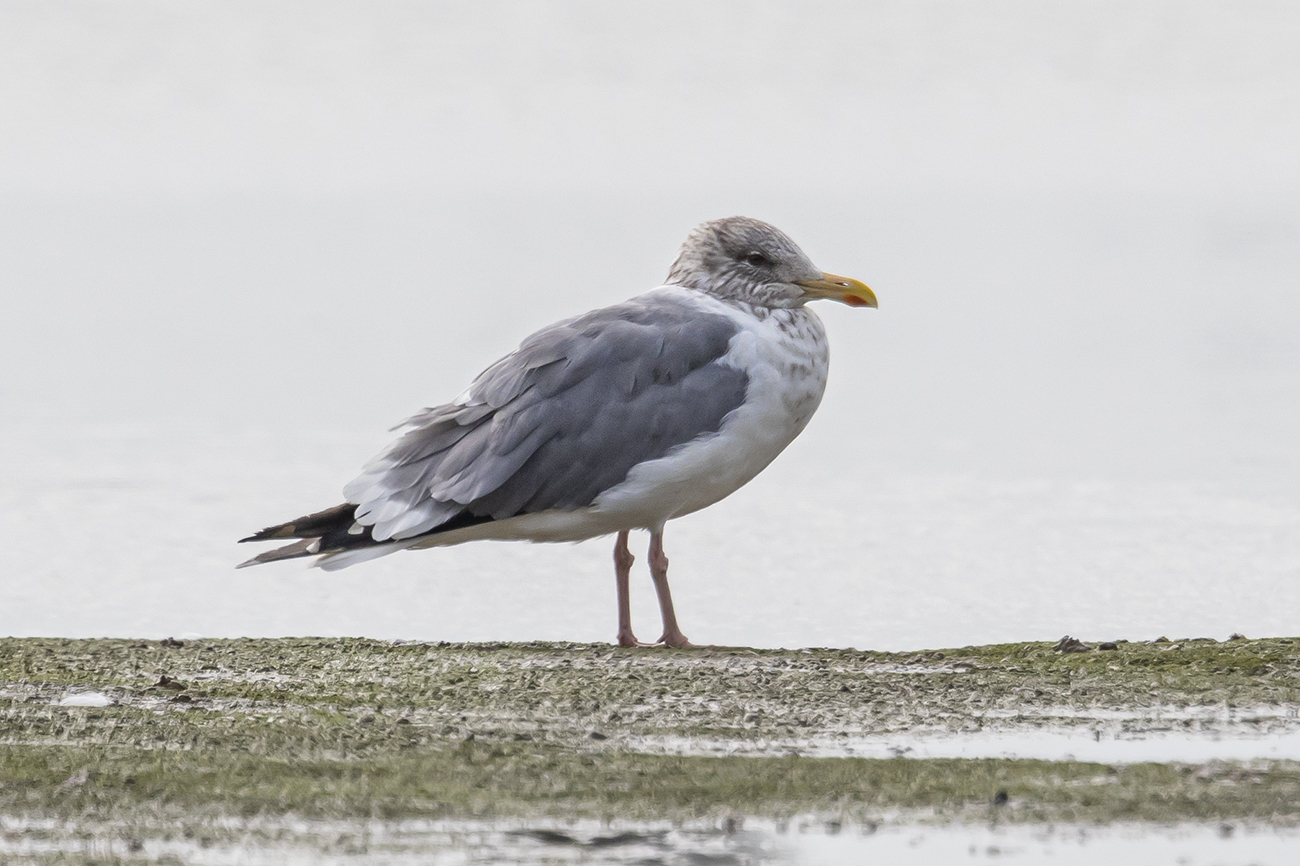
In general it is believed that Heuglin's Gulls are the most common species in Hong Kong, adults having darker mantles, smaller stature and yellowish legs. sub-adults should is equally dark backed but with heavier streaks on head, plus dark tip to bill. 2cy birds are not easy to identify with Vega Gulls of similar age, reason being 2cy birds have pinkish legs, however their rounded heads often provides a clue.
Heuglin's Gull - adult
Heuglin's Gull - sub-adult
Heuglin's Gull - 2cy
Mongolian Gull
- Largest of the three species
- Adults with lightest shade on back
- Head often looking longer with slanted foreheads
- Adults moults into breeding plumage earlier, head all white earlier on in the year
- juveniles have paler head and often white foreheads.
- Legs of all ages pinkish
- Darker iris
The second most common species in Hong Kong, adults are easy to pick out from the rest as they often moult into breeding plumage early, so their complete white heads are often easy to pick up. Individuals of all age should show paler heads even in 2cy birds when compared with the other two species. Foreheads often white with no streaking. Legs pinkish. Often described as a rather 'full chested' gull with larger bill and stronger build.
Mongolian Gull adult with Heuglin's Gull to the left
Mongolian Gull - adult with 3cy bird
Mongolian Gull - 3cy
Mongolian Gull - 2cy
Vega Gull
- Slightly larger than Heuglin's Gull, but smaller than Mongolian.
- Heavier built and more robust than Heuglin's
- Heavily streaked head in all ages except adult in breeding
- Mantle shade somewhat in-between Heuglin's and Mongolian.
- Legs pinkish to reddish
- Iris slightly darker in adult than Heuglin's
Supposedly the scarcest of the three species, although I have a feeling that juveniles are constantly being identified as other species or simply ignored. Adults have very smoky heads, often heavily streaked and blotched from crown to breast. I lack confidence to identify any juveniles to this species, I saw one likely 3cy bird that was much darker and heavily streaked both on head and breast, also quite a bulky looking bird which I feel points more towards Vega.
Vega Gull - adult (taken last year for comparison)
Vega Gull - adult
Vega Gull - likely 3cy bird with adult Mongolian Gull to the left
I have yet gain enough confidence to nail the id for each gull, that will likely take a much longer time to master...Spotting a gull out of the ordinary from the three species was however slightly easier. I noticed a large gull with fairly dark belly but pale wings amongst the flock, it's white primaries were especially apparent when it flapped it's wings! Pink legs, bi-coloured bill with pink base and pale primaries all points towards a 2cy Glaucous Gull. It was on the small side for a Glaucous, I received mixed comments about this bird's identity, while some suggested that this could be a hybrid Glaucous x Slaty-backed or something...Although for me this seems unlikely, seeing that most hybrid Glaucous Gulls often shows distinct abnormal features such as darker or monotoned bill and darkened primaries, which this bird showed none of those features. Personally I would happily accept this as a Glaucous Gull towards the smaller end of the species's spectrum, although if the true identity of this gull should not be considered a Glaucous Gull then I must say gulling is probably way too difficult for my liking...


Glaucous Gull - 2cy
Back to some birds with little doubt of it's identity, the Black-capped Kingfisher showed well next to the bird hide, a species with such irresistible colours!
Black-capped Kingfisher
A Black Kite also perched close to the bird hide briefly, which allowed some closeup shots to be taken. While a few Temmink's Stints ventured to the front of the hide as the tide came in.
Black Kite
Temmink's Stint
Eurasian Wigeons and Northern Shovelers were numerous, many of them came in very close to the front of the bird hide, so close even that I was able to see the lamellae lined along the Shoveler's bill, it acts like a sieves to filter out any crustaceans and plankton in the mud and water.
Eurasian Wigeon - drake (right) & female (left)
Northern Shoveler - drake & female
Black-faced Spoonbills are starting to moult into breeding plumage, this particular individual came right up to the bird hide to the point where I could hardly fit it all in frame! Shorebirds species had yet to pickup, I only counted a few species including this Whimbrel and Common Redshank at close quarters, we should be getting some more species in the coming months.
Black-faced Spoonbill - assuming breeding plumage
Whimbrel
Common Redshank
Back inside Mai Po I saw the Black-backed Swamphen yet again, although this time it was even further so I did not even bother with a photo. Though an adult Purple Heron which stood right out in the open was much worthier of a photo!
Purple Heron
Gulls identification is challenging indeed, but it is good exercise for the brain...if you can stay awake long enough....
Mongolian Gull - yawn