Upon hearing news of a Little Curlew at Mai Po from Wednesday to Friday, I headed over at my earliest convenience that was Saturday morning. It was a classic twitch where I was a day late...As I had work later in the afternoon, I only had time at scrape 16/17. It was so unfortunate that a friend of mine gave me news a little bit later that they had a Spoon-billed Sandpiper out at the mudflat. I was totally gutted...I did try to scan for the Spoonie when the waders flew into the scrape, but simply could not locate one amongst the huge flocks of Red-necked Stints...There were also lots of other waders coming into roost, including lots of Sharp-tailed Sandpipers and Curlew Sandpipers.

Flocks of Red-necked Stints...no Spoon-billed Sandpiper...

Sharp-tailed Sandpiper
The long staying Greater White-fronted Goose strolled past the front of my hide, it was the only one left overwintering here at Mai Po, it looks to be a pretty young bird and I think it's probably very lost without any older Geese to guide it through it's supposed northward journey. It's fate remains uncertain!

Greater White-fronted Goose
Some other birders tried for the Spoonie on Sunday, but no one spotted it again. I decided to give it another try on Monday. As I walked towards the gate to the boardwalks, I was greeted by a few Chinese Penduline Tits at the reed bed. Striated Herons had also returned, one perched long enough for me to grab a record photo.

Chinese Penduline Tit

Striated Heron
I arrived at the new hide at around 9:30am, there were a lot more people than I expected for a Monday...obviously everyone wanted to glimpse the rare Spoon-billed Sandpiper...I settled down and started scanning through the mudflat with my scope...A few Kentish Plovers were very close to the hide, both males and females in breeding plumage.
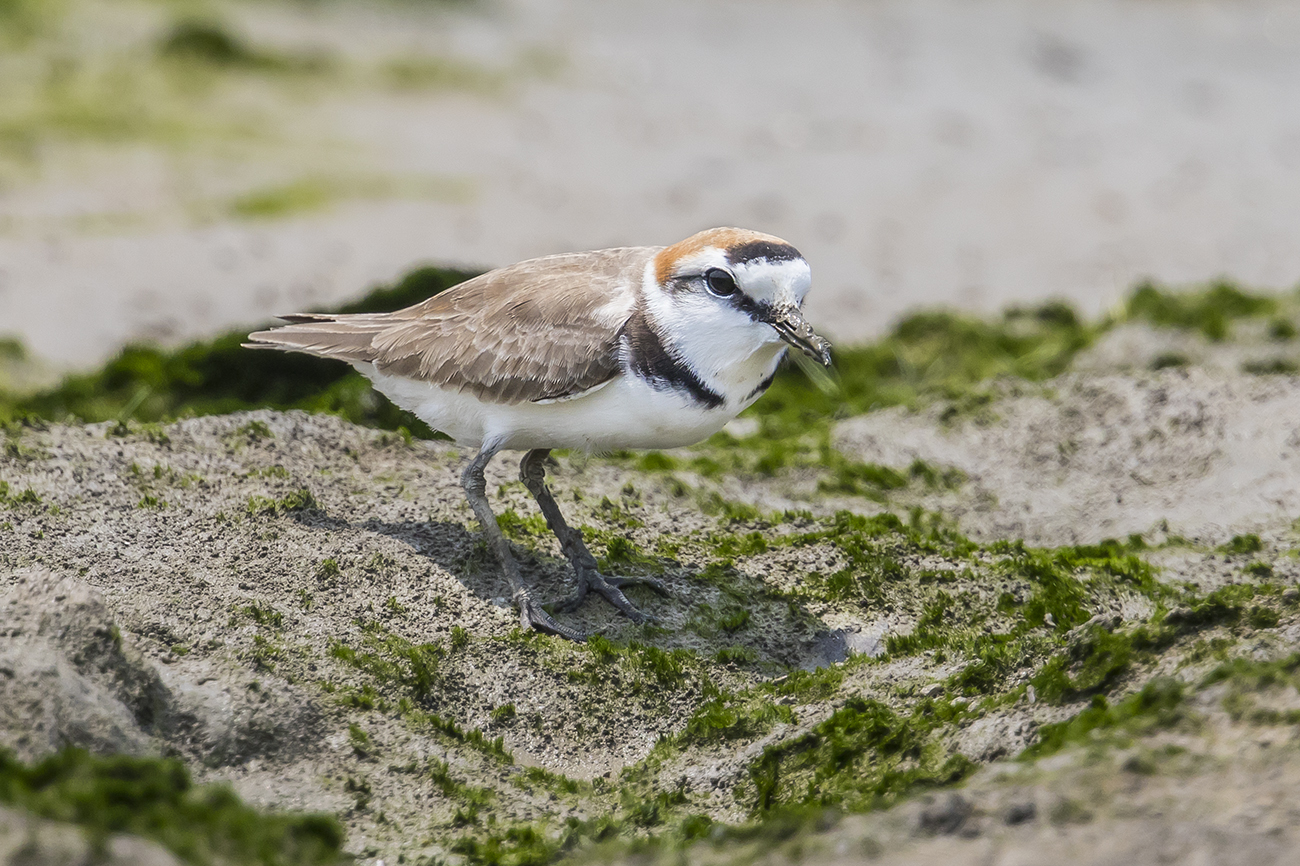
Kentish Plover - male

Kentish Plover - female
There were a few Grey-tailed Tattlers around, although not as many as I expected. Flocks of Long-toed Stints walked along the front of the hide as well.

Grey-tailed Tattler

Long-toed Stint
I scanned the flock of Red-necked Stints in the distance, sure enough saw a very good looking Little Stint in breeding plumage. As Little Stints moult into their very bright orange plumage, they become very obvious.

Little Stint & Sanderling
As the tide came in higher, other species started arriving. A few good looking Ruddy Turnstones strolled along the front of the hide, feeding on small crabs. While a few Sanderlings also gave good views at close range, they are very pale compare with other waders present, making them quite conspicuous.

Ruddy Turnstone

Sanderling
Both Mongolian Plovers and Greater Sand Plovers ventured to the front of the hide, here you can clearly see the difference in their structure and bill shape, Mongolian having a very stubby and short bill, while Greater Sand Plover have a much longer and stronger bill.

Mongolian Plover

Greater Sand Plover
I of course continuously scanned the large flocks of Red-necked Stints, hoping to find a Spoonie amongst them...All I got were Red-necked Stints with muddy bills...

Red-necked Stint
I spotted yet another Little Stint amongst the flock close to the bird hide in amongst the Red-necked Stints. This one was not as brightly coloured as the other one, but still a very handsome individual, especially when seen so close!


Little Stint
There were still plenty of Curlew Sandpipers around, I was able to get a few closeups of the few that ventured to the front of the hide. A single Red-necked Phalarope also made an appearance. As the tide came in higher and covered up all the mud, I knew my chances of finding a Spoon-billed Sandpiper was pretty much gone, so I decided to move to the middle hide to look for other waders.

Curlew Sandpiper

Red-necked Phalarope

Waders as the tide came in
I was just in time as the tide was still coming in at the middle hide, there I spotted a few very good looking Red Knots. This is another near threatened species that seems to be in decline in recent years, mainly due to habitat loss along the East Asian Australasian Flyway.


Red Knot
Another similar species that is facing the same problem is the Great Knot, now an endangered species. While another endangered species, a few Far Eastern Curlews roosted nearby, I counted a total of 8 individuals.

Great Knot

Far Eastern Curlew
I spotted 3 Nordmann's Greenshanks roosting amongst the Common Redshanks and Marsh Sandpipers. It is yet another endangered species for the day, with an estimation of no more than 1,300 individuals remaining in the wild, we are fortunate to still get them in small numbers in Hong Kong and can often pick them out with relative ease.


Nordmann's Greenshank
A single Swinhoe's Egret was also present, although this time it was much further away. There were still a lot of Black-faced Spoonbills around, I counted up to 30 birds. While two Eurasian Spoonbills had stayed on.

Swinhoe's Egret

Black-faced Spoonbill

Eurasian Spoonbill
I scanned scrape 16/17 one last time on my way out, most of the smaller waders were roosting and had their head tucked under their wings...not useful when you are trying to scan for Spoon-billed Sandpipers, I was left feeling quite defeated, but that's just birding sometimes, there are birds you won't be able to find no matter how hard you try.

Flocks of waders roosting at scrape 16/17
The day ended on a happier note, where I found quite a few Greater Painted Snipes strolling about in the open. It is breeding season for them, so they are currently very active. I won't be surprise if we see the males followed by a few chicks in a month or two.


Greater Painted Snipe - female


