Showing posts with label Great Knot. Show all posts

Friday, 10 April 2020

Critically Endangered Spoonie - Spring Migration at Mai Po

If you ask birders what is the most critically endangered bird species in Hong Kong, I am sure most of them will answer 'Spoon-billed Sandpiper'. This charismatic little wader is no doubt considered the holy grail of all migrants in Hong Kong, and a highly sought-after species for all birders globally. This species had always been rare, but in recent decades their population plummeted from over a few thousands to merely a few hundreds. Now listed as critically endangered and on the verge of extinction, ornithologists are racing to save this species from the abyss, and this begins with understanding their migration route.

The Spoon-billed Sandpiper breeds in the arctic tundra of Siberia, with major wintering population in Bangladesh and Thailand. Hong Kong being situated along the East Asian-Australasian Flyway is blessed to be one of the migratory stop for this species, mostly recorded in spring. With so few left in the wild, finding them in Hong Kong is becoming increasingly difficult, as only a handful passes through Deep Bay area annually, and each only staying a few days at most. A pair was reported on the 7th of April, I was at Mai Po on the 8th hoping to find them on the scrape but ultimately failed. It was again reported on the morning of the 9th, apparently seen well from hide 3 on the scrape of Mai Po, a quick dash there resulted in over an hour of superb views!

Spoon-billed Sandpiper - one of the rarest bird species in the world

It had been well over a decade since my last encounter with this incredible species, although I do remember back then finding them were a little bit easier...This bird was tagged '1T', an individual part of the artificial incubation programme ringed in 2016 at Meinypil’gyno, Chukotka in Far North East Russia. It was great to see this bird in great shape, actively feeding with other waders including Red-necked Stints, Little Stints, Curlew Sandpipers and Lesser Sand Plovers. Hopefully with better understanding of their migration route we will be able to secure more suitable habitat for their long term survival.


Spoon-billed Sandpiper - feeding amongst Broad-billed Sandpipers & Lesser Sand Plovers

April is no doubt the best time for waders in Hong Kong, other than Spoon-billed Sandpipers, birders scanning the Red-necked Stints may also be rewarded one or two Little Stints. While Curlew Sandpipers, Broad-billed Sandpipers, Sharp-tailed Sandpipers, Lesser and Greater Sand Plovers are often plentiful.

Little Stint - with numerous Red-necked Stints

Curlew Sandpiper & Greater Sand Plover

Sharp-tailed Sandpiper with Curlew Sandpiper, Broad-billed Sandpiper & Greater Sand Plover

A flock of over 20 Oriental Pratincoles flew overhead, a species fairly common during migration. Bar-tailed Godwits were in fairly good numbers, some already moulted into their beautiful breeding plumage, while the more common Black-tailed Godwits usually move in one big flock.

Oriental Pratincole

Bar-tailed Godwit

Black-tailed Godwit

Spoon-billed Sandpiper is not the only threatened bird present on the scrape...many species had declined rapidly throughout the years and are now listed as endangered species. The Nordmann's Greenshank is also globally rare, with an estimated population of less than 1300. Great Knots and Far Eastern Curlews numbers are also decreasing, but both are still regularly seen around Deep Bay area.

Nordmann's Greenshank

Great Knot

Far Eastern Curlew

The congregating waders do occasionally attract the 'wrong crowd', raptors often take advantage of this food source and hunts regularly at the scrape. A Black Kite was seen eating a bird in front of the bird hide, although I do not know what bird it caught. A Peregrine Falcon also came through for a quick meal, as it snatched a Curlew Sandpiper out of the sky, the poor sandpiper nearly escaped in the water, but ultimately the Peregrine finished it off...

Black Kite


Peregrine Falcon - preying on Curlew Sandpiper

Two species are often associated with Mai Po, one is the Pied Kingfisher which was the bird of the logo of Mai Po Nature Reserve, they are indeed pretty common here and often put on quite a show in front of the bird hide. The other is of course Black-faced Spoonbill, somewhat of a conservation fairytale, with numbers dwindling to a few hundreds in 80s, their numbers are now increasing steadily annually. This individual was a rescued bird by the Kadoorie Farm, it was fitted with a satellite tracker on its back and later released when it recovered.

Pied Kingfisher

Black-faced Spoonbill - with satellite tracker

Other than waterbirds, I also came across a singing Eastern Crowned Warbler, they are fairly common during migration. While along the footpath I spotted three Chinese Cobras, a species with a bad reputation of being aggressive, although all three I encountered did not even bother to raise their hoods at me, given enough space they are pretty harmless.

Eastern Crowned Warbler

Chinese Cobra - Naja atra

Outside of Mai Po, I went past Sunny Bay and found an Eurasian Hoopoe, a species I haven't seen in a while. I first detected it when it took flight from the ground and perched up on a tree, it later flew back on the lawn to feed, picking up worms and grubs in the ground. Hoopoes are generally scarce in Hong Kong, but regularly recorded during migration and occasionally during winter.


Eurasian Hoopoe


Forecasts predicts a bit of rain over the weekend, which may again ground some migrants, we shall see!

Thursday, 26 April 2018

Waders Scanner

Upon hearing news of a Little Curlew at Mai Po from Wednesday to Friday, I headed over at my earliest convenience that was Saturday morning. It was a classic twitch where I was a day late...As I had work later in the afternoon, I only had time at scrape 16/17. It was so unfortunate that a friend of mine gave me news a little bit later that they had a Spoon-billed Sandpiper out at the mudflat. I was totally gutted...I did try to scan for the Spoonie when the waders flew into the scrape, but simply could not locate one amongst the huge flocks of Red-necked Stints...There were also lots of other waders coming into roost, including lots of Sharp-tailed Sandpipers and Curlew Sandpipers.

Flocks of Red-necked Stints...no Spoon-billed Sandpiper...

Sharp-tailed Sandpiper

The long staying Greater White-fronted Goose strolled past the front of my hide, it was the only one left overwintering here at Mai Po, it looks to be a pretty young bird and I think it's probably very lost without any older Geese to guide it through it's supposed northward journey. It's fate remains uncertain!

Greater White-fronted Goose

Some other birders tried for the Spoonie on Sunday, but no one spotted it again. I decided to give it another try on Monday. As I walked towards the gate to the boardwalks, I was greeted by a few Chinese Penduline Tits at the reed bed. Striated Herons had also returned, one perched long enough for me to grab a record photo.

Chinese Penduline Tit

Striated Heron

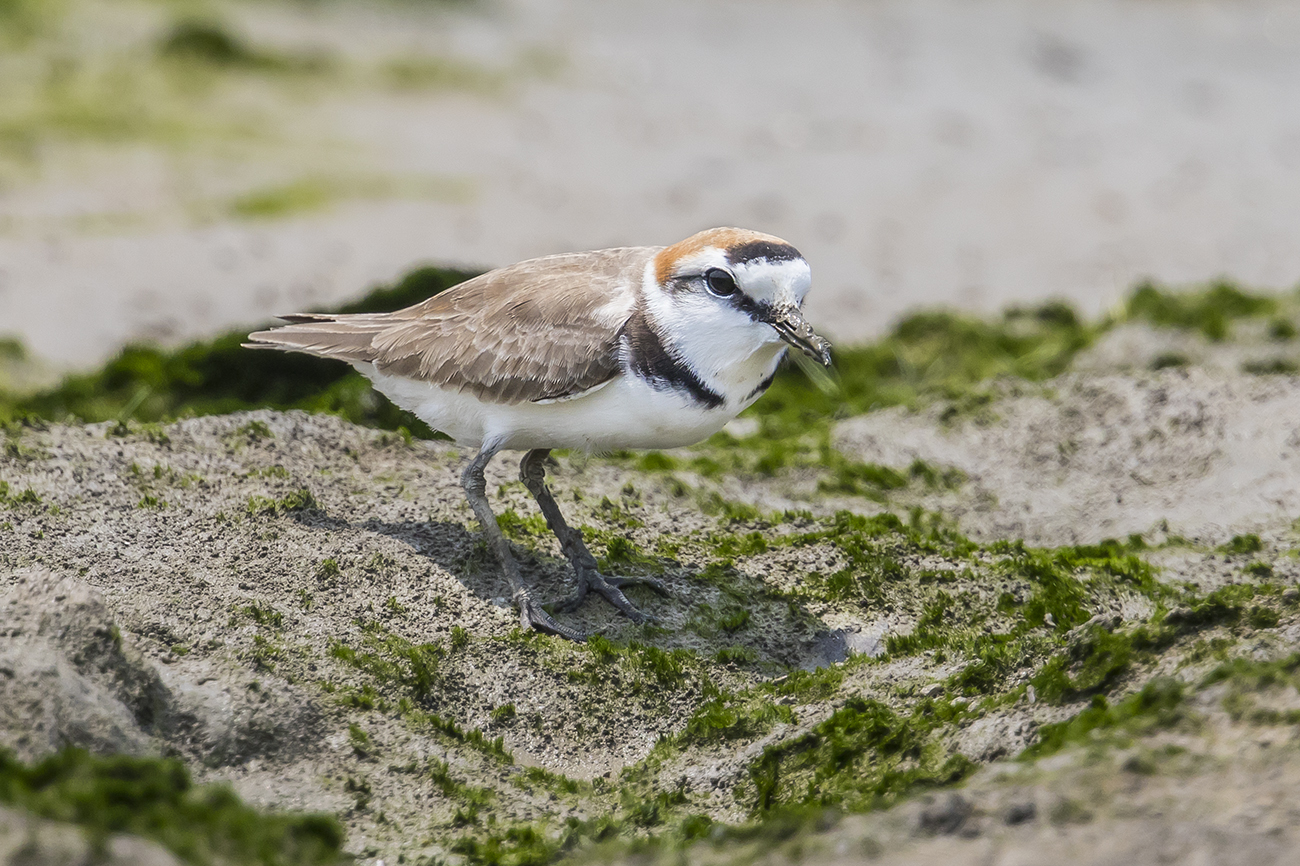
I arrived at the new hide at around 9:30am, there were a lot more people than I expected for a Monday...obviously everyone wanted to glimpse the rare Spoon-billed Sandpiper...I settled down and started scanning through the mudflat with my scope...A few Kentish Plovers were very close to the hide, both males and females in breeding plumage.

Kentish Plover - male

Kentish Plover - female

There were a few Grey-tailed Tattlers around, although not as many as I expected. Flocks of Long-toed Stints walked along the front of the hide as well.

Grey-tailed Tattler

Long-toed Stint

I scanned the flock of Red-necked Stints in the distance, sure enough saw a very good looking Little Stint in breeding plumage. As Little Stints moult into their very bright orange plumage, they become very obvious.

Little Stint & Sanderling

As the tide came in higher, other species started arriving. A few good looking Ruddy Turnstones strolled along the front of the hide, feeding on small crabs. While a few Sanderlings also gave good views at close range, they are very pale compare with other waders present, making them quite conspicuous.

Ruddy Turnstone

Sanderling

Both Mongolian Plovers and Greater Sand Plovers ventured to the front of the hide, here you can clearly see the difference in their structure and bill shape, Mongolian having a very stubby and short bill, while Greater Sand Plover have a much longer and stronger bill.

Mongolian Plover

Greater Sand Plover

I of course continuously scanned the large flocks of Red-necked Stints, hoping to find a Spoonie amongst them...All I got were Red-necked Stints with muddy bills...

Red-necked Stint

I spotted yet another Little Stint amongst the flock close to the bird hide in amongst the Red-necked Stints. This one was not as brightly coloured as the other one, but still a very handsome individual, especially when seen so close!


Little Stint

There were still plenty of Curlew Sandpipers around, I was able to get a few closeups of the few that ventured to the front of the hide. A single Red-necked Phalarope also made an appearance. As the tide came in higher and covered up all the mud, I knew my chances of finding a Spoon-billed Sandpiper was pretty much gone, so I decided to move to the middle hide to look for other waders.

Curlew Sandpiper

Red-necked Phalarope

Waders as the tide came in

I was just in time as the tide was still coming in at the middle hide, there I spotted a few very good looking Red Knots. This is another near threatened species that seems to be in decline in recent years, mainly due to habitat loss along the East Asian Australasian Flyway.


Red Knot

Another similar species that is facing the same problem is the Great Knot, now an endangered species. While another endangered species, a few Far Eastern Curlews roosted nearby, I counted a total of 8 individuals.

Great Knot

Far Eastern Curlew

I spotted 3 Nordmann's Greenshanks roosting amongst the Common Redshanks and Marsh Sandpipers. It is yet another endangered species for the day, with an estimation of no more than 1,300 individuals remaining in the wild, we are fortunate to still get them in small numbers in Hong Kong and can often pick them out with relative ease.


Nordmann's Greenshank

A single Swinhoe's Egret was also present, although this time it was much further away. There were still a lot of Black-faced Spoonbills around, I counted up to 30 birds. While two Eurasian Spoonbills had stayed on.

Swinhoe's Egret

Black-faced Spoonbill

Eurasian Spoonbill

I scanned scrape 16/17 one last time on my way out, most of the smaller waders were roosting and had their head tucked under their wings...not useful when you are trying to scan for Spoon-billed Sandpipers, I was left feeling quite defeated, but that's just birding sometimes, there are birds you won't be able to find no matter how hard you try.

Flocks of waders roosting at scrape 16/17

The day ended on a happier note, where I found quite a few Greater Painted Snipes strolling about in the open. It is breeding season for them, so they are currently very active. I won't be surprise if we see the males followed by a few chicks in a month or two.


Greater Painted Snipe - female