Showing posts with label Two-barred Warbler. Show all posts

Monday, 4 May 2020

Japanese Paradise Flycatcher - Look at That Tail!

Of the many amazing looking spring migrants in Hong Kong, nothing quite compares to the Japanese Paradise Flycatcher in breeding plumage. Their long tail that cascades down their back gives them a very distinctive look when they hawk for insects in the forest, it is even harder to imagine this magnificent creature flying over oceans during migration from the Philippines back towards Japan! These incredible looking birds don't usually stay long, I was lucky to be tipped by Captain about one at Tai Po Kau late last month, fortunately enough for me the bad weather must have grounded the bird and it stayed long enough for me to relocate it within a bird wave.

Japanese Paradise Flycatcher - male

I have not seen one of these beautiful males since April 2007, so I was very please to see this one so well! It didn't stay long for me, I only had the bird in view for two minutes before it fluttered off back into the depth of the forest. The Japanese Paradise Flycatcher is now listed as Near Threatened due to habitat loss throughout much of its wintering range.

Japanese Paradise Flycatcher - male

Grey-streaked Flycatchers were still in good numbers near the end of April, but saw a decrease in numbers once the weather improved. There must have been over a dozen individuals along the Tai Mei Tuk Catchment. A Chestnut-winged Cuckoo have been frequenting the catchment, although being very shy as usual, despite much effort I ended up with only a record shot through the leaves.

Grey-streaked Flycatcher

Chestnut-winged Cuckoo

At Tai Tong, I encountered a very confiding female Chinese Goshawk, it remained perched even when I walked right up to it, they are a species I very much enjoy seeing every time. Around the reservoir I spotted a juvenile White-bellied Sea Eagle, which gave good flyby views before perching on a tall tree further away.

Chinese Goshawk - female

White-bellied Sea Eagle - juvenile

Other confiding birds at Tai Tong includes a mob of Red-billed Blue Magpies, a common species that I still love seeing up close, a few were feeding in a picnic area on the ground. A large flock of Greater Necklaced Laughingthrush were also unusually confiding, this species is not very often photogenic, but these were feeding just a few metres away from me.

Red-billed Blue Magpie

Greater Necklaced Laughingthrush

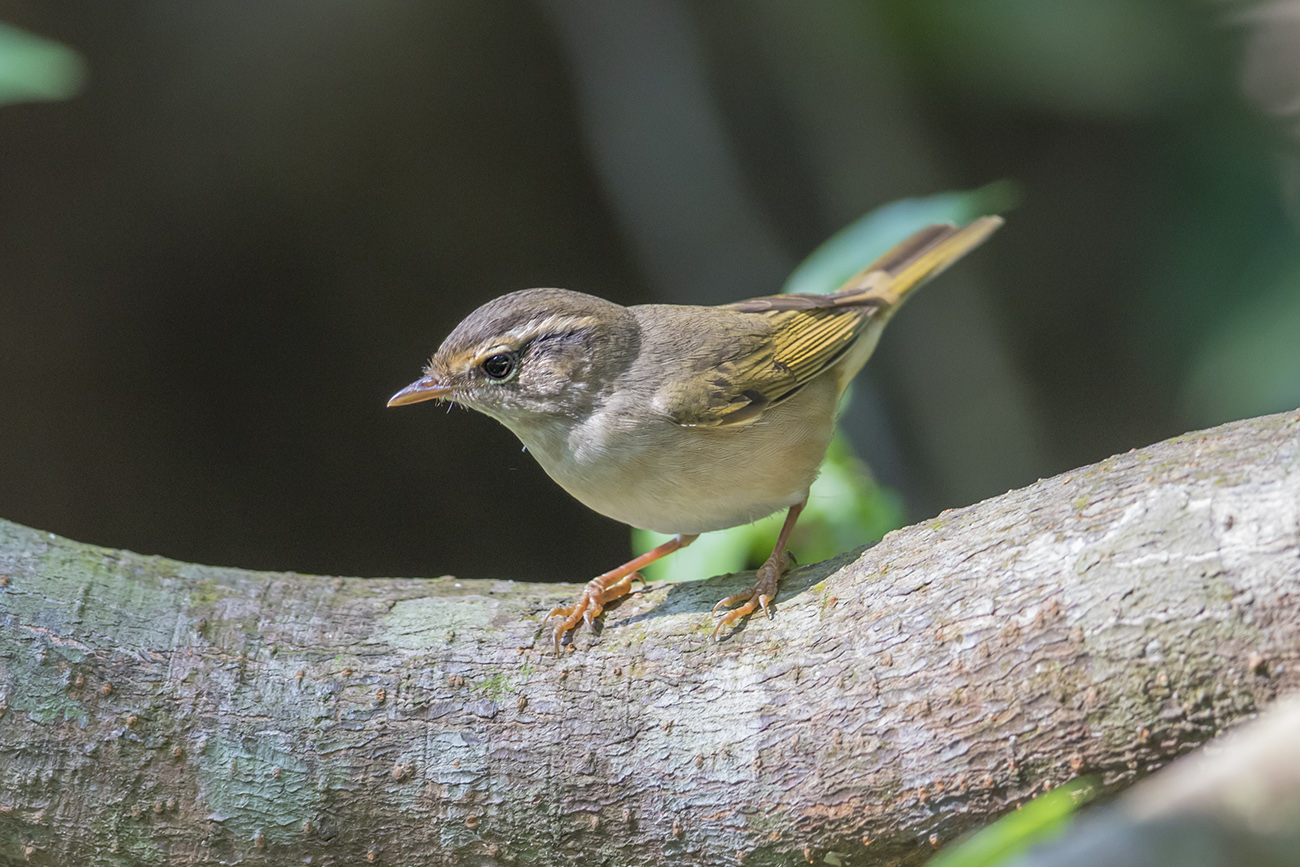
I didn't find anything new around my local patch, but a Two-barred Warbler at Tai Mei Tuk Family Walk was a nice bird to see, it however made a very Greenish like call which confused me to begin with, but overall plumage fits Two-barred more. It was seen actively feeding with a few Swinhoe's White-eyes and Rufous-capped Babblers, later it perched up to preen which allowed some decent photos to be taken. This is a fairly late individual which stayed till May, but latest date recorded in Hong Kong is 15th of May.


Two-barred Warbler

Sunday, 15 April 2018

Quietness Continues

Spring had been eerily quiet, at least it seems so to me anyway. I have not seen a single Blue-and-White Flycatcher or even any Asian Brown Flycatcher so far! Could be just unlucky, but I usually encounter at least one or two during late March to early April...The weather certainly haven't helped much, it's been one of the driest spring in recent years, we barely had any rain at all.

Visited Shing Mun this week, again I was hoping to find at least one or two migrating flycatchers, but saw none. The long staying Slaty-backed Forktail however showed well, it was still frequenting the same stretch of stream as it was a few months ago. It's certainly nice to have this species around, I've always enjoyed watching them flicking their black and white tail up while hopping through the rocky streams. Around the same area I heard a Speckled Piculet calling but it never showed itself.


Slaty-backed Forktail

There are a lot of Damselflies around at the moment, I found many Indochinese Copperwings along the river, a beautiful species that is widespread in suitable habitats in Hong Kong.

Indochinese Copperwing - Mnais mneme

More Hainan Blue Flycatchers had arrived, I counted up to five birds at Shing Mun, all singing males. One of which was singing particularly close to the road and gave excellent views at eye-levels. They seems to be the only flycatcher species I have been seeing all spring.


Hainan Blue Flycatcher - male

The only other bird note worthy was a scruffy looking Two-barred Warbler. It did not make it's diagnostic call, although dark legs, pale lower mandible and strong second wing-bar looks to be a good fit.

Two-barred Warbler

At San Tin, a drained fishpond attracted good numbers of waders, I counted at least 11 species in the pond. There were a couple of Sharp-tailed Sandpipers around, as well as Curlew Sandpipers and Long-toed Stints. Red-necked Stints and Greater Sand Plover were in smaller numbers. There was also a single Terek Sandpiper, as well as the other common wader species.


Sharp-tailed Sandpiper

Curlew Sandpiper, Wood Sandpiper & Long-toed Stint

Red-necked Stint & Greater Sand Plover

Finally, Whiskered Terns are starting to return, we should see many of this elegant species filling up our fishponds really soon before they fly further north to breed. So, enjoy while they last!


Whiskered Tern - breeding plumage

Thursday, 26 October 2017

Shing Mun Reservoir and Slightly Off Grid

Radde's Warbler

I seldom visited Shing Mun Reservoir these days, and thinking about that I couldn't really think of a reason why that is, it is close to where I live, trail there is easy to walk, it is connected to the same patch of forest to Tai Mo Shan and Tai Po Kau...

Arriving at the start of the reservoir trail kind of reminded me why I have slowly neglected this site; monkeys! In small numbers they are fun to watch and kind of cute, but once you get hundreds of them in one place they really starts to get on your nerves. The Rhesus Macaques we get in Hong Kong are not a native species, they were likely introduced many years ago. To be fair they never really done anything to me, although past experiences had told me usually the more monkeys the less birds. Or is it?

Rhesus Macaque - the baby ones sure looks cute...

For the first half hour or so I got very little birds, slowly picking up pace I managed to get great views of a Pygmy Wren Babbler which is always a treat. Further along I even got an eye-level view of a Mountain Tailorbird which perched long enough for me to get a good photo. Getting such good views of these two major skulkers requires a lot of luck, so I consider myself quite lucky. I spotted a Dark-sided Flycatcher above the trail, so views weren't great but was still happy to get this passage migrant.

Pygmy Wren Babbler

Mountain Tailorbird

Dark-sided Flylcatcher

Things really picked up when I got to picnic area no.5, where I encountered a bird wave. All the common birds showed well, including Grey-chinned Minivets, Blue-winged Minlas, Yellow-cheeked Tits and Velvet-fronted Nuthatches. I also spotted an Eastern Crowned Warbler and a female Verditer Flycatcher, although both were too quick for any photos.


Grey-chinned Minivet - male (above) & female (below)

Blue-winged Minla

Yellow-cheeked Tit - female

The best bird in the flock was a female Japanese Paradise Flycatcher, this species is scarcer in autumn. It's the first for me this autumn and certainly an exciting species to see at all times! There was also a male recorded at Ho Man Tin earlier this month, the males lack the long tails that is the trade mark for all Paradise Flycatchers after the breeding season.

Japanese Paradise Flycatcher - female

I ran into another bird wave just before the public toilet, this time there were a few White-bellied Epornis actively feeding. I even managed yet another Japanese Paradise Flycatcher! This time it seems to be a juvenile due to the lack of eye-rings. A few Ashy Drongos were around but only one leucogensis showed reasonably well.


White-bellied Epornis

Japanese Paradise Flycatcher - immature

Ashy Drongo - leucogenis

I saw a warbler feeding quite low down, olive brown with no wing bars, thick eye brows that is yellowish to the front, pale legs and pale lower mendible...surely a Radde's Warbler! This is a scarce autumn migrant, with a few recorded every year. They look slightly similar to a Dusky Warbler, but you can easily tell them apart from the eye brows, where the dusky is paler to the front and buffish to the back, the Radde's is the other way round. Their overall structure and bill shape is also very different. The most different thing with those two are behaviour, whereas most Duskies are quick and skittish, the Radde's are usually much more friendly, it was the case for this bird, which gave excellent views for as long as I wanted.


Radde's Warbler - very friendly

I continued on, adding a few commoner species here and there including the Asian Brown Flycatcher and a single Taiga Flycatcher. I later saw a Dusky Warbler plus a Goodson's Leaf Warbler as well. At picnic area no.12 I saw two warblers on the trees, first a Yellow-browed Warbler, but there was another that had much darker legs and paler lower mendible. A closer look revealed faint first and thicker second wing bars, yellowish wash to the underside surely make this a good candidate for a Two-barred Warbler, and soon it gave a pipit like "tiss-yip" call, which confirms it's identity.


Two-barred Warbler
In the afternoon, Hoiling said she wanted to visit the Dragon Trail at Cape Collinson, a place I have never visited before. This location is fairly "off the grid", being very under birded. A quick change of bus from Hung Hom cross harbour tunnel and we were there. The trail walking up the hill seemed like a popular hiking spot and we saw plenty of hikers. We soon encountered what seems to be one of the local speciality there, a family of Wild Boars, they certainly did not fear men, my 500mm was WAY too close to fit the whole animal in frame. Boar numbers certainly had been on the rise in recent years, and without the South China Tigers that once preyed on these animals, their numbers will surely continue to grow.


Wild Boar

The second specialty here seems to be Chinese Hwamei, a species that is common but usually extremely shy. Here, they were foraging in broad daylight and out in the open, certainly quite a nice experience to be able to view this species so well.


Chinese Hwamei

The other species that was also oblivious to men here was the Blue Whistling Thrush, we saw a few here, one of them was so bold that it actually jumped towards me as I was trying to photograph it, and I ended up having to walk backwards to the other side of the road. A magnificent bird to look at as always. Further along the trail Hoiling spotted a snake inside a water outlet pipe, which turned out to be a Red-necked Keelback, a common diurnal snake in Hong Kong.

Blue Whistling Thrush

Red-necked Keelback

Finally, I spotted a juvenile male Blue Rock Thrush on the way down, which I felt was a great bird to end the day with. Certainly an afternoon well spent!

Blue Rock Thrush - philippensis