Showing posts with label Sai Kung. Show all posts

Friday, 6 December 2019

Winter Spectacular - Japanese Night Heron and more

I have been itching to update the blog but had been so caught up with work and a recent trip to Osaka (more of that later on) that I've not been able to do so. The most notable rarity of late is a Japanese Night Heron that had been showing exceptionally well at Sai Kung. Ironically it was reported when I was in Japan...First thing after we got back Hoiling and I went straight in the morning and found the bird straight away! This endangered species is only the 7th confirmed record in Hong Kong, and one of the rarest heron in the world! With no more than 2,000 individuals globally!


Japanese Night Heron - 7th HK record!

Back tracking a few weeks back, we had a successful tour outing on 16th of November. The day began with good views of a Brown Wood Owl at Tai Lam Country Park. While two Dark-sided Flycatcher made an appearance, a brilliant looking male Blue-and-White Flycatcher really stole the show. A male Red-flanked Bluetail was also quite nice, this year had been especially good for this species. A single Black Bulbul was a nice addition on the day. The half day tour ended at Long Valley with great views of Yellow-breasted Buntings and a Chestnut-eared Bunting.

Brown Wood Owl - been very consistent and showing well

Dark-sided Flycatcher

Blue-and-White Flycatcher - male

Red-flanked Bluetail - male

Black Bulbul

Chestnut-eared Bunting

November was also very busy for us because of the moving, but now that we have settled in I am starting to explore my new local patch around Ting Kok and Brides Pool area. One of the most remarkable bird I found on my first outing was a single Northern Lapwing on the coast, which later gave an incredible fly-by view.


Northern Lapwing - a great patch tick!

A grassy area nearby was also incredibly productive, with Yellow-breasted Bunting, Chestnut-eared Bunting and Black-faced Bunting all showed well.
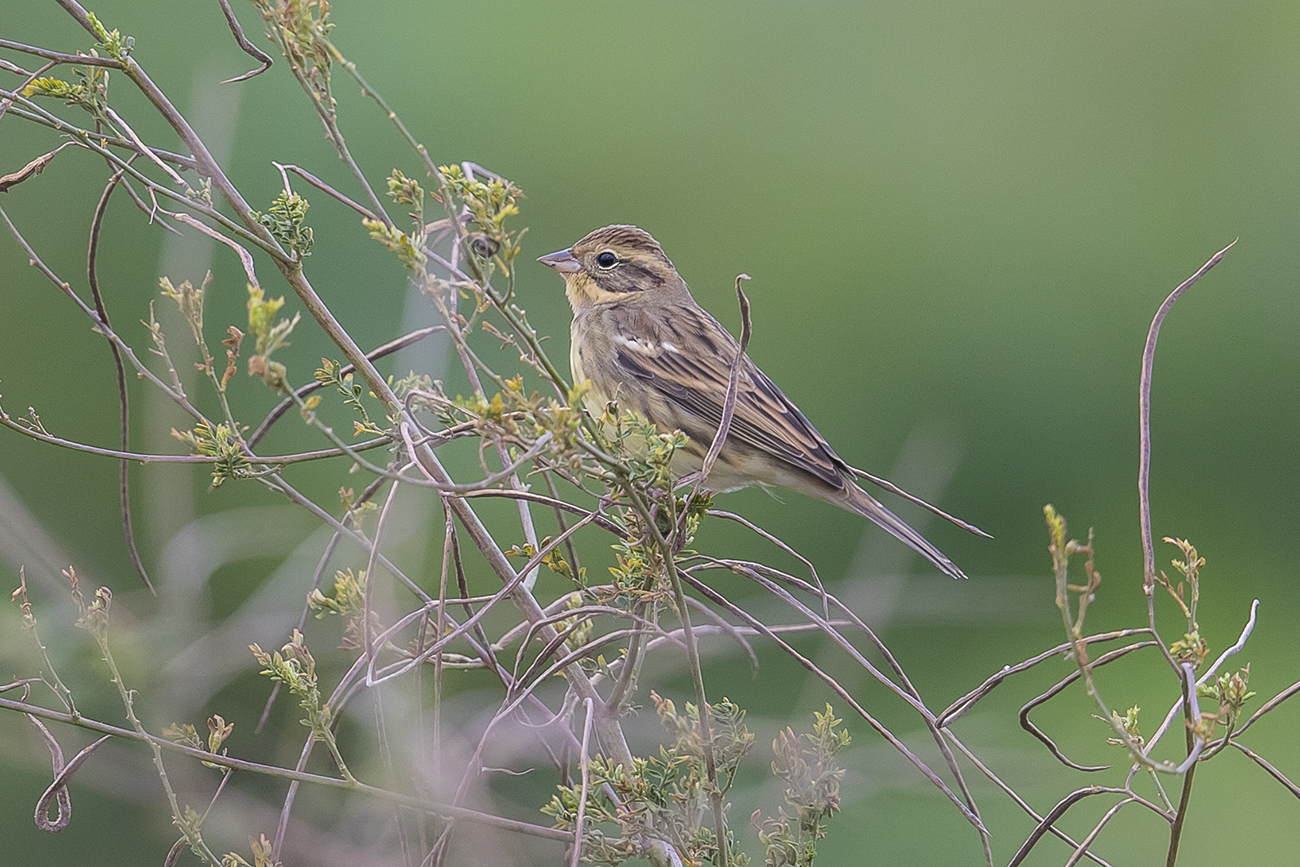
Yellow-breasted Bunting

Chestnut-eared Bunting

Black-faced Bunting

At Wu Kau Tang where I've rarely birded in recent years I had success with finding a Speckled Piculet plus up to two Small Niltava! One of the male even showed quite well! Being so accessible to so many great bird really is a privilege!

Speckled Piculet

Small Niltava - male

A Black-necked Grebe had been found recently at San Tin, of which I have failed to connect with on each of my attempts...I did however connect with a very confiding Great Crested Grebe, which we don't see very often up close!


Great Crested Grebe

The Ferruginous Duck reported near Mai Po stayed on for a week or two, I went back for some better photos and ended up with some good flight shots.


Ferruginous Duck - inflight shots

A few Yellow-browed Buntings were reported at Long Valley of which I missed despite there on the same day, I was however rewarded with a Rustic Bunting which showed fairly well. With 'rice season' coming to an end soon, it is nice to finally see one of the less common visitors to Long Valley.

Rustic Bunting - always a delight to see

Monday, 5 February 2018

Cold Spell - Birding's Magic

Mugimaki Flycatcher

Start of February and we are experiencing some pretty bitter cold, Tai Mo Shan froze over and temperature dropped down to -1.8℃, while temperature around New Territories dropped to just 4℃. Weather like this certainly affects the birds, I experienced this first hand when I saw this dead Common Tailorbird which couldn't make it through the bitter night. Although in general colder weather means that birds in general are easier to observe, with some often shy species changing their behaviour completely, it's a good time to go out and experience the magic...

Common Tailorbird - unfortunate victim of the cold

I visited Shek Kong Airfield before I had work to do, a trio of Common Rosefinch greeted me. They were quite busy feeding and showed beautifully, there were two males and a single female together. Although an annual winter visitor, it's still a real privilege to see them so well.


Common Rosefinch - male & female

At nearby Lam Tsuen, a flock of Hair-crested Drongos were feeding much lower than usual, at one point I observed one bird coming down to the ground to pick off an insect. A Common Kingfisher was also found along the Lam Tsuen River, a regular species along this stretch.

Hair-crested Drongo

Common Kingfisher

I visited Mai Po again with Hoiling on the 1st, our main target was the Oriental Stork which Hoiling had not seen before. While walking there we observed an aerial battle between an Eastern Marsh Harrier and a Collared Crow, later joined in by a Black Kite! It was quite a show with three birds chasing one another, I was quite pleased to be able to capture a photo with all three birds all in one frame!

Fight between Eastern Marsh Harrier, Collared Crow and a Black Kite

We waited at pond 23 for the Stork when we didn't see it at pond 21. It was very cold to stand in the wind, our hot tea kept us happy. We waited for what felt like 30 minutes in the cold with nothing happening, as we were just about to leave a great commotion of egrets caught our attention and we were suddenly seeing the huge stork in flight! It soon landed on pond 23 for some perched views, although it was quite far away for any decent shots. Also present was an adult Peregrine Falcon, the rather dark face mask indicates this as race peregrinator.

Oriental Stork

Peregrine Falcon - spp. peregrinator

The alteration of birds behaviour was especially apparent at a BBQ site in Sai Kung, where a few birds had been seen feeding out in the open. One of such example was a 1st winter male Mugimaki Flycatcher, actively feeding near the ground and occasionally coming to within a few feet.


Mugimaki Flycatcher - feeding on the ground

A 1st winter male Fujian Niltava was also present, although not showing as well as the Mugimaki, but still offered fairly good looks briefly. Fujian Niltavas are rare winter visitors in Hong Kong, their absolutely stunning plumage makes them joyous birds to look at and a thrill to see every time.


Fujian Niltava - 1st winter male

Around the same area, a 1st winter Orange-headed Thrush foraged out in the open. It was still a little skittish, but you kind of feel it's urgency to find more food and would occasionally even venture out to the benches and tables. Although it kept a safe distance away from me the whole time and later went back into the thickets when a large group of tourists arrived.


Orange-headed Thrush - 1st winter

There were a few "less attractive" present, namely a duo of female Daurian Redstarts, they will occasionally chase the Mugimaki Flycatcher around, probably not as much as it would do in warmer weather. A 1st winter male Siberian Rubythroat also made a brief entrance, but mainly stuck within the thickets and out of view as usual!

Daurian Redstart - female

Siberian Rubythroat - 1st winter male

Other than the winter visitors, a few resident species also made an appearance, other than a lot of Common Tailorbirds and Cinerous Tits, a Mountain Tailorbird also dropped in briefly, feeding fairly low down at eye-levels. A large dove flew by and landed in a tree near me, a quick look revealed it to be an immature Emerald Dove; a usually shy species which stayed long enough for me to grab a half decent record shot.

Mountain Tailorbird

Emerald Dove

Despite the long cold spell, nothing out of the ordinary had appeared so far, was kind of hoping for something like Yellow-bellied Tit...but I should remain hopeful as long as the cold persists!

Sunday, 31 December 2017

The Last Push

Slaty-backed Forktail - last addition to my year list

I was looking through my 2017 bird record near the end of December and I couldn't help noticing how enticingly close my year list is to 300 species. I've never gotten past 300 species in a year before, so this became a little goal to aim for during the last month of 2017. A few days before the new year and when I recounted my records I noticed I was up to 304 species, naturally I would love to squeeze out what is left in the year.

The most obvious target of mine was the Chestnut-crowned Warbler at Lung Fu Shan which I have already missed on two occasions. I was determined to nail this bird, and after some encouragement from fellow birders I gave this bird a third try. It was third time lucky, as I located the bird by it's faint high pitched call, and soon found it feeding amongst a few Pallas's Leaf Warblers, it's bright yellow underside and greyish throat and breast was pretty unmistakable. The bird later came down to eye-levels and gave some really good views! Therefore completing my Lung Fu Shan duo of both Small Niltava and Chestnut-crowned Warbler. So that was my 305th species.


Chestnut-crowned Warbler - third time lucky!

On the 30th I decided to add one last species onto my year list, a Slaty-backed Forktail that had been around the stream next to picnic area 7 at Shing Mun Reservoir and was my best bet for adding one last species. I arrived quite early that morning, on the way picking up a bird wave with a single male Verditer Flycatcher as highlight. I also encountered a large flock of Indochinese Yuhinas which gave close views.

Verditer Flycatcher - male

Indochinese Yuhina

The walk to picnic area 7 took nearly 40 minutes, there was no sight of the Forktail when I arrived, so I sat down and waited. It wasn't until 9:30am that the Forktail finally showed itself, as it flew in and foraged along the tree trunks and rocks for a few minutes before flying off once again. It was a long time ago since I last saw one in Hong Kong, back when one regularly visited the stream at Tai Po Kau. Although I see this species a lot in Guangdong in similar habitats, they have never took off in Hong Kong somehow and remains to be a rare occasional visitor. Why that is we may never know, but I certainly hope we get them in Hong Kong more regularly, as they are awesome looking birds, and very happy to get it as my 306th species of the year.


Slaty-backed Forktail - mysteriously rare in Hong Kong

My last day of the year was spent at Long Ke Wan, I was doing a nature tour as part of an land art camp organised by Art Together. The camp allowed participants to experience and create art in nature, there was a kite making session with natural materials which everyone enjoyed immensely. The area around Long Ke Wan is extremely scenic, situated within the Hong Kong Geopark, it is certainly one of the most beautiful places in Hong Kong. We even hiked up the hill to look at the first sunrise of 2018 to start off the year!

Kites made with found twigs

Feral Cattles are commonly found around Hong Kong's country parks


Beautiful area around Long Ke Wan

1st Sunrise of 2018

The area is not a birding hotspot, as it's surrounded by mainly scrubland, I heard a few Brown-flanked Bush Warblers and Russet Bush Warblers around the surrounding hills. A very friendly Blue Rock Thrush of the race pandoo was one of the better birds I found in the area, I usually see race philippensis, pandoo seems to be far less common in Hong Kong.


Blue Rock Thrush - male ssp. pandoo

For the nature tour, I took the participants on a short walk around the camp site, looking for birds and other interesting creatures around us. We were very fortunate to get a very cooperative Common Kingfisher which fished in the small lagoon, everyone gave a lot of "oooo's" and "ahhh's" when it dived for fish right in front of us. The most impressive bird though was probably a pair of White-bellied Sea Eagles duetting loudly on the surrounding hills, a species that I find to be the most impressive looking bird of prey in Hong Kong. They are most likely a pair breeding in the area, although I am not sure whether they have a nest yet or simply trying to find a suitable place to build one. Either way they certainly impressed the participants as much as they impressed me.

Looking at the Common Kingfisher

White-bellied Sea Eagle - a beautiful pair