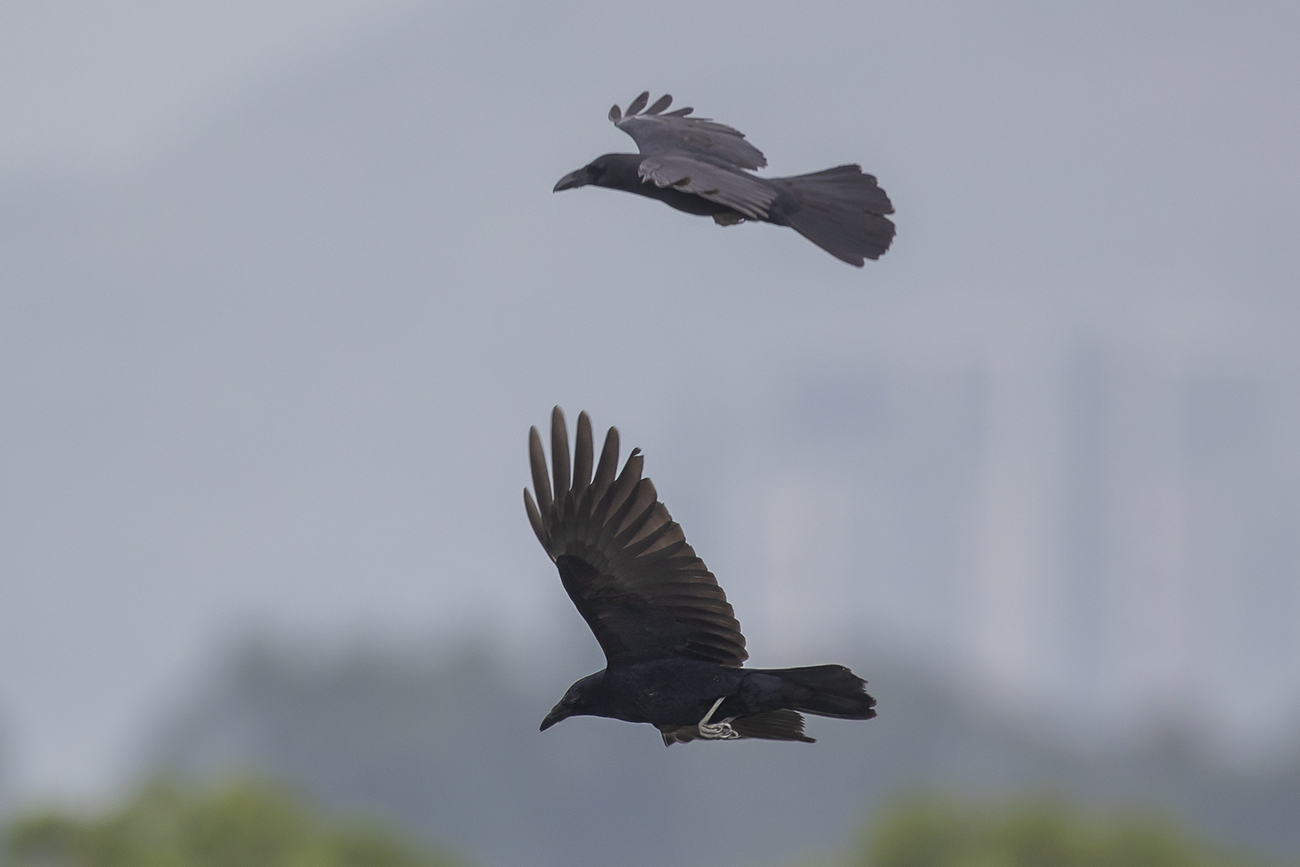
One man's trash is another man's treasure, this is very true in birding, where one species maybe very common in one country, but consider a rarity in another. Roman found two Rooks near Lut Chau and posted a few photos up to instagram, I noticed that one of the 'rook' looked slightly weird, with heavier and thicker bill. Turns out he found a Carrion Crow along with the Rooks! Its been many years since I last seen a Carrion Crow in Hong Kong, although it was something I used to see almost daily when I was in the UK, but it is no doubt a rarity in Hong Kong! It took my third try to locate it at Lut Chau, where after scanning for 30 minutes in the cold I finally caught sight of it with Large-billed Crows and Collared Crows.
 |
| Carrion Crow - a twitchable bird for us none the less |
Carrion Crows maybe mixed up with juvenile Rooks, the bill of Rooks are thinner and pointier, with less curved on the upper mandible. This particular individual was frequenting in between Lut Chau and Mai Po, often coming out to the fish ponds to feed and roosting on trees in Mai Po.
 |
| Carrion Crow |
Occasionally some Large-billed Crows may also have less 'stepped' forehead, which may be mistaken for Carrion Crows, but Large-billed Crows have a much thicker bill, and slightly longer as well. I've always thought the shape of the bill of Carrion Crows is similar to that of Collared Crows.
 |
| Carrion Crow (below) and Large-billed Crow (above) |
 |
| Collared Crow |
Olive-backed Pipits are now returning and not difficult to find along well vegetated tracks along Tai Sang Wai. Daurian Redstarts continues to be in great numbers this year, some extremely confiding such as this female.
 |
| Olive-backed Pipit |
 |
| Daurian Redstart - female |
Whiskered Terns are mainly passage migrants in Hong Kong, but we occasionally get a few wintering in Hong Kong. A long staying Pheasant-tailed Jacana at Tai Sang Wai will occasionally pop its head out for birders to see.
 |
| Whiskered Tern |
 |
| Pheasant-tailed Jacana |
The Booted Warbler at Fung Lok Wai continued to show well for any birders looking for it, often confiding and at close range. The fish ponds in the area is probably the best area for reed warblers at the moment, with more Black-browed Reed Warblers I can count, I managed to find one more Manchurian Reed Warbler still lingering, while a few Oriental Reed Warblers were also present.
 |
| Booted Warbler |
 |
| Manchurian Reed Warbler |
 |
| Oriental Reed Warbler |
The shrubs and bushes around the fish ponds also provided plenty of shelter for birds such as Black-faced Buntings, I counted no less than five Siberian Rubythroats in one morning, with one male showing particularly well. At least two Eurasian Wrynecks also been present, although not always easy to photograph.
 |
| Black-faced Bunting - male |
|
 |
| Black-faced Bunting - female |
 |
| Siberian Rubythroat - male |
 |
| Eurasian Wryneck |
Other wetland species easily found here includes Eastern Marsh Harriers, which often patrols the area in early morning. Eurasian Coots are not as common as they used to be in Hong Kong, I am glad to find them in good numbers here still at Fung Lok Wai. A single Yellow Bittern was spotted along the reed beds, while Common Kingfishers can be found here with relative ease.
 |
| Eastern Marsh Harrier |
 |
| Eurasian Coot |
 |
| Yellow Bittern |
 |
| Common Kingfisher |
Over at Mai Po, Black-faced Spoonbills have now returned, we are lucky in Hong Kong that getting close views of this iconic species is a regular occurrence. If you sit around long enough in the bird hide, you often find raptors coming around, such as this Western Osprey. Numerous ducks have returned, I managed to grab a few shots of a pair of Eastern Spot-billed Duck flying across.
 |
| Black-faced Spoonbill |
 |
| Western Osprey |
 |
| Eastern Spot-billed Duck |
Bunting season is right about now, unfortunately Long Valley is now out of bounds due to the construction of the nature park. With the limited access I only managed a pair of Rustic Buntings and a few Little Buntings. I have been seeing Yellow-breasted Buntings here and there, but not quite as easy to photograph outside of Long Valley.
 |
| Rustic Bunting - female |
 |
| Little Bunting |