Weather's still incredibly warm for end of October, with midday still up to 29 - 30°C, an improvement from the 35°C at the beginning of the month, but not the cool autumn days that I've come to love. That being said, some good birds have been seen, while not all rarities were twitchable (a White-browed Crake inside Long Valley for instance is 'out of bounds' for birders, though some do venture inside), I've enjoyed the casual birding around the places quite a lot, places like Tai Sang Wai have been quite productive of late, and continue to turn up a steady stream of decent birds, such as Manchurian Reed Warblers, which seems to be in good numbers this year, I saw at least two different individuals on separate days, both showing extremely well! First one seen during a half day tour, after a tough morning at Tai Po Kau we got lucky with this very showy individual, which hopped up to the top repeatedly.
 |
| Manchurian Reed Warbler |
The second individual was spotted during an outing with HKBWS, it was found dozing off at close range! My guess is that this was a newly arrived individual still exhausted from all the flying. While many confuse the Manchurian Reed Warblers with Black-browed Reed Warblers, the more you look at them the easier it gets in separating the two. Structurally they are very different, Manchurian having a much longer bill and often look quite 'big headed', Black-browed have a much slimmer and shorter bill. The supercilium on Manchurian is not as prominent and the black brow above the supercilium is often washed out or sometimes very thin, whereas in Black-browed they are always very dark and bold.
 |
| Manchurian Reed Warbler |
 |
| Black-browed Reed Warbler |
The tall grass not only attracts Reed Warblers, but also Prinias and Cisticolas, Plain Prinias are very common in Hong Kong, you can find them in most wetlands with tall grass, with a bit of patience they often can pose quite nicely. Both Zitting and Golden-headed Cisticolas spend their winters in Hong Kong, the latter is less common but can often be found making their distinctive 'zeeeeeeee' call inside the tall grass.
 |
| Plain Prinia |
 |
| Zitting Cisticola |
 |
| Golden-headed Cisticola |
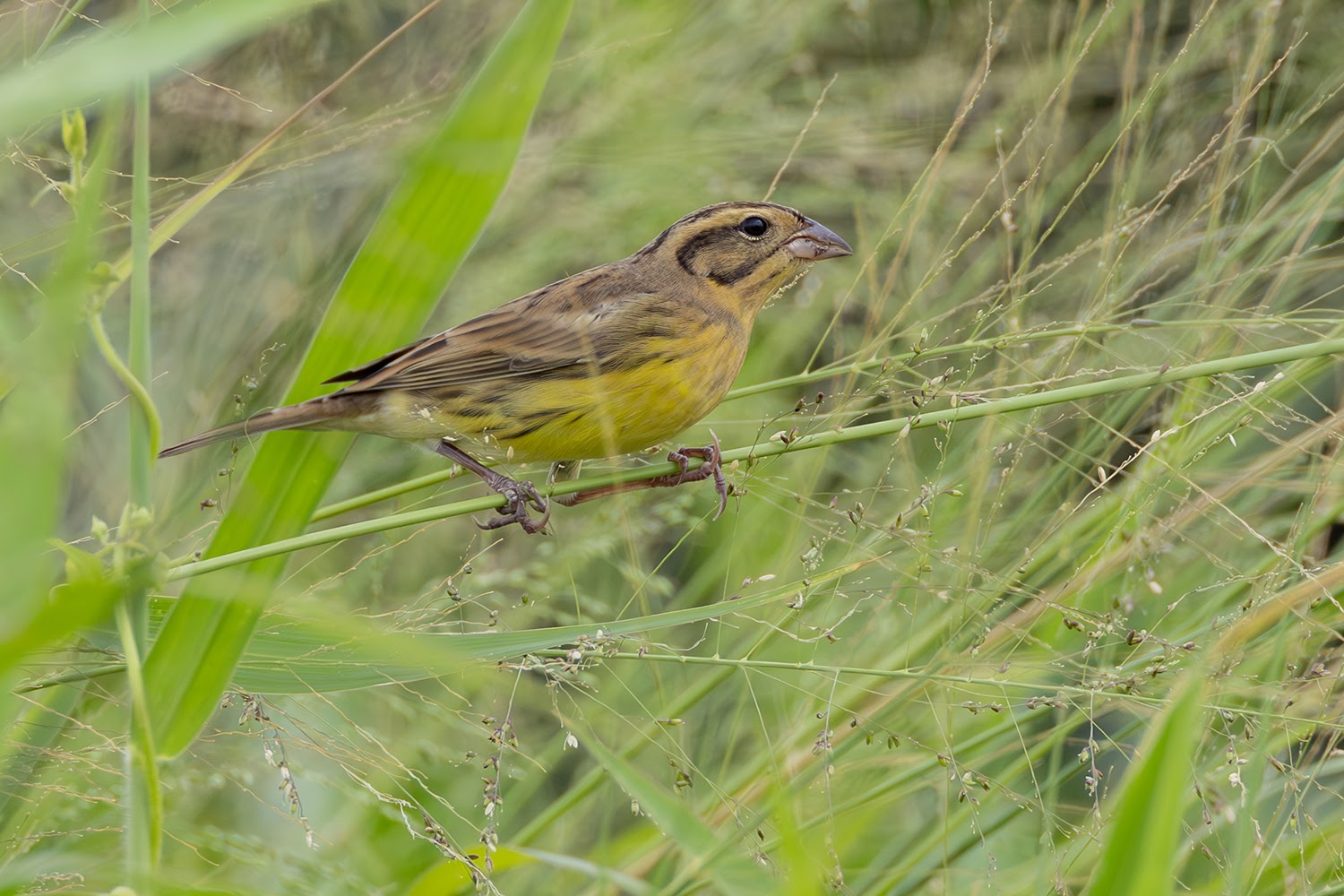
Other goodies at Tai Sang Wai includes a few Yellow-breasted Buntings, I was lucky with a pair of them feeding next to the footpath, which gave quite close views. I've found bunting numbers not been as high as previous years, for example I've only seen a few Little Buntings so far, whereas usually they should be quite easy to see by this time of the year.
 |
| Yellow-breasted Bunting |
The male Northern Red Bishop is still around Tai Sang Wai, attracting tons of photographers chasing it around, which I am not sure why anyone bother, it is a very handsome bird, but being a released bird I am sure why anyone will be so interested in it. A more interesting find around the fish ponds includes a Citrine Wagtail, a species that I don't see very often nowadays. A few Eurasian Hobbies occasionally come through, although I've not had any luck with Amur Falcons at close range this year.
 |
| Northern Red Bishop |
 |
| Citrine Wagtail |
 |
| Eurasian Hobby |
The small group of Pheasant-tailed Jacanas are still present on the 'Jacana Pond', I do wonder how long they will stay there, at the moment they seem pretty contented to continue staying there as long as there's food. The Bailon's Crake there seems to be showing more often, occasionally at close range. At another drained pond there are often a few waders present, a Dunlin was spotted there on my last visit.
 |
| Pheasant-tailed Jacana |
 |
| Bailon's Crake |
 |
| Dunlin |
Over at Lut Chau, a drained pond attracted many egrets as well as Black-faced Spoonbills to feed, this juvenile came very close to my car giving excellent views at close range.
 |
| Black-faced Spoonbill |
I've not had as much success at Ma Tso Lung lately, but still you see a few half decent birds along the way. There's been a few fairly tamed Red Collared Doves around, which posed nicely as long as you stay in the car, here's a male and a juvenile.
 |
| Red Collared Dove - male |
 |
| Red Collared Dove - juvenile |
A drained pond there attracted a lot of egrets and a few Spoonbills as well, other than a few Black-faced Spoonbill, a single Eurasian Spoonbill was also seen amongst the flock. Common Snipes are now everywhere, frequenting drained pond bunds, where they can often be found roosting out in the open.
 |
| Black-faced Spoonbill with Great and Little Egrets |
 |
| Eurasian Spoonbill |
 |
| Common Snipe |
Tai Po Kau's been pretty boring this whole month, only a few regular migrants and nothing else, even the common residents were not showing well at all! Crested Serpent Eagle is regularly seen perched on its favourite tree, while a male Verditer at Tai Po Kau Park was the best I could manage over there.
 |
| Crested Serpent Eagle |
 |
| Verditer Flycatcher - male |
I gave Shek Kong Catchwater a try, and it seems slightly better, at least the common forest birds were more willing to show, and gave fairly good views, including a Speckled Piculet. A single Grey-headed Canary Flycatcher was a first for me this season.
 |
| Speckled Piculet |
 |
| Rufous-capped Babbler |
 |
| Grey-chinned Minivet - male |
 |
| Grey-headed Canary Flycatcher |