Showing posts with label Lam Tsuen. Show all posts

Sunday, 27 November 2022

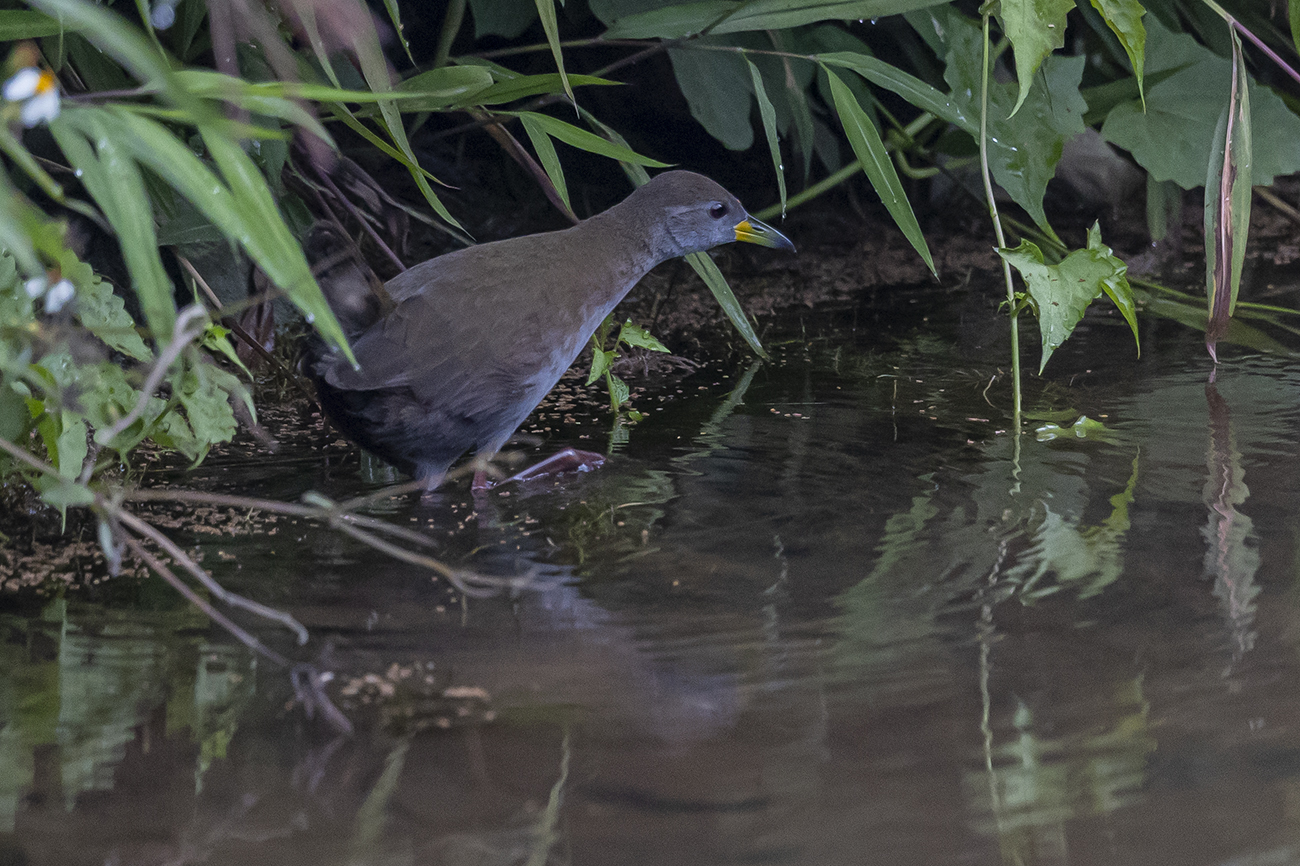
My 500th Hong Kong Bird - Brown Crake

Over the years I have missed several major rarities for various reasons, most notably between 2003 and 2009 I was mostly away from Hong Kong. Brown Crake was one of those rare birds that eluded my Hong Kong list for years, since the relatively easy one at Nam Chung back in 2009, theres not been any twitchable ones. So, when one was reported in Lam Tsuen it was an opportunity I dare not miss. I am not sure why this species is so difficult in Hong Kong, as it is a relatively common species in China, I've seen them several times in Jiangxi and Guangxi. This rather shy individual only show up in the morning and often while it's still quite dark. Luckily for us, this bird seems to appear like clockwork and appear briefly each morning.


Brown Crake

With this bird, I have officially reached 500 species on my Hong Kong list. This had been a target for me for quite some time. Glad that my 500th species was a great one! 

Brown Crake - my 500th bird in Hong Kong

I visited Wu Kau Tang one morning, walking towards Sheung Miu Tin, it was drizzling slightly and later turned to actual rain. Before the rain came in I managed a rather confiding Radde's Warbler, although the light conditions was horrendous for photos. Rufous-tailed Robins are now back and saw quite a few of these along the trail. Theres been a large influx of Indochinese Yuhinas of late, I've been seeing them everywhere including urban areas! So, I wasn't surprise to find quite a few flocks here. A Lesser Shortwing decided to show itself on this dim morning, while a relatively common species, I don't get to see them often enough.

Radde's Warbler

Rufous-tailed Robin

Indochinese Yuhina

Lesser Shortwing

I led a half day outing to San Tin and Tai Sang Wai recently, a rather enjoyable morning with a flushed Yellow-legged Buttonquail being the best bird, although it was too quick and there was no way I could have gotten a photo. A rather nice looking Eastern Yellow Wagtail amongst other more drab looking ones was quite unusual given the time of the year, but every so often we get some birds retaining some of the breeding plumage through the winter months. An Osprey circling above was one of the several raptor species we had that morning. Several Yellow-breasted Buntings were seen, two of which allowed relatively good views. Black-faced Buntings and Little Buntings both showed well.

Eastern Yellow Wagtail - race taivana

Osprey

Yellow-breasted Bunting - female

Black-faced Bunting - male

After the tour I returned to Tai Sang Wai briefly to hopefully relocate the Buttonquail, which obviously was not seen again. But, I did find a very confiding male Yellow-breasted Bunting feeding on the road, probably the closest I've ever been to this species! It was hard to resist taking more photos of this awesome bird, I ended up with hundreds of photos of it feeding, thought I shouldn't miss the chance of an up close experience with a critically endangered species.


Yellow-breasted Bunting - friendly individual

Thursday, 17 December 2020

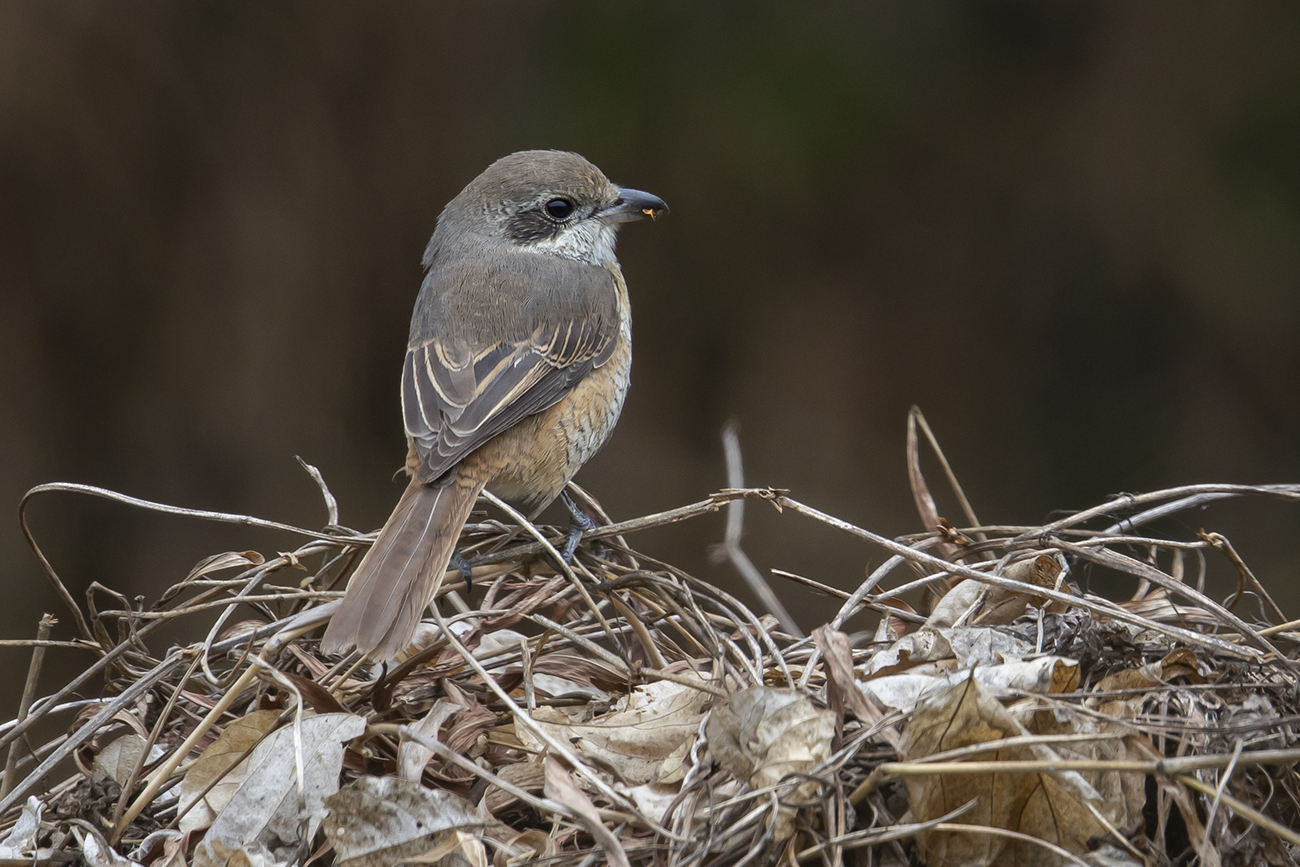
Shrike Three! - 3rd Grey-backed Shrike in Hong Kong

Grey-backed Shrike is quite the rarity in Hong Kong, having only been recorded once in 2015. News of another adult Grey-backed Shrike surfaced not too long ago, unfortunately the bird was within the compound of Kadorie Farm, which is closed off to visitors at the moment. This was only the 2nd record for Hong Kong and one that many birders would love to see. To our delight, John Allcock found another 1st winter bird in Lam Tsuen, where the bird was stable and showed fairly well. Most birders were able to enjoy prolonged views of this wonderful vagrant.


Grey-backed Shrike - 1st winter

Being a 1st winter shrike, you can imagine identification to be tricky and not straight forward. This was absolutely the case for this bird, as most birders including me could have easily put it down as a Brown Shrike and moved on. There are a few differences to look out for, 1st winter Grey-backed Shrike should show the following features:

1. Heavier bill
2. Longer tail
3. Greyer mantle
4. Ear patch browner
5. Heavily marked breast

Grey-backed Shrike - 1st winter

For comparison, here is a photo I took of a 1st winter Brown Shrike a few days prior at Long Valley, although the tail length is blocked by the branch, features you can see here are:

1. Very warm toned mantle
2. Ear patch darker
3. Breast lightly marked

Brown Shrike - 1st winter

Other interesting observations at Long Valley includes a Javan Mongoose strolling along the river, I have not seen one of these for a while, it is always a thrill to see a mammal in Hong Kong. Most Buntings have left by now, leaving mainly Sparrows and Munias behind, the White-headed Munias are still in good numbers, I have a feeling they are here to stay...

Javan Mongoose

White-headed Munia

Shek Kong area had been fairly productive for some, I didn't really encounter anything too interesting, although a very large flock of Minivets was an absolutely joy to behold, most of them were feeding at eye-levels at extremely close range. Velvet-fronted Nuthatches were in no short supply, while Crested Goshawk is always a thrill to see up close.

Grey-chinned Minivet - female

Grey-chinned Minivet - male

Velvet-fronted Nuthatch

Crested Goshawk

I was expecting to find Common Rosefinch or Yellow-billed Grosbeaks at Shek Kong Airport Road, despite the cooler weather they seem to be missing. I did however managed a very confiding Asian Brown Flycatcher and a lot of Hair-crested Drongos,

Asian Brown Flycatcher

Hair-crested Drongo

Things at Mai Po were slightly better, the best bird of late being a male Baikal Teal in full plumage, although it was only seen on one day and not relocated, an eclipse male was found in the scrapes and remained there for quite a few days. I have not seen this species for many years now, so it was nice to catch up with them again. The pair of Greater White-fronted Geese were exactly where I last left them, still grazing along the buffalo field.

Baikal Teal - eclipse male

Greater White-fronted Geese

You often see Eastern Imperial and Greater Spotted Eagles in Mai Po during winter months, although you are unlikely going to get good photos of them every single time. Eastern Buzzards were in very good numbers, saw no less than four around the reserve.

Greater Spotted Eagle

Eastern Buzzard

Other notable birds includes a fairly confiding Yellow Bittern, which showed very well. Black-faced Buntings were in good numbers and many were feeding along the access road. I also saw what I believe to be a Common Reed Bunting briefly along the reed bed at 8a, but views were rather brief, but it did look much warmer toned than Pallas's Reed Bunting.

Yellow Bittern
Black-faced Bunting

Tai Po Kau had been excellent for warblers, despite the fact that I missed the White-spectacled Warblers seen there by other birders, a good range of warblers have been consistently showing well. The numbers of Hartert's Leaf Warblers seems to be an all time high, with both goodsoni and fokiensis. Sulphur-breasted Warblers are in no short supply lately, at least three were seen in the bird wave.

Hartert's Leaf Warbler - goosoni

Sulphur-breasted Warbler

At least two Kloss's Leaf Warblers had been spotted amongst the warblers in the bird waves, good thing they were calling, or else I think it would have been difficult to determine their identity, as they look superficially similar to fokiensis Hartert's Leaf Warblers. Although another good indication is a good look at their undertail pattern, where Kloss's shows a much thicker pale inner edge of their tail feather, and Hartert's inner edge are often much thinner, as demonstrated by the photos below.
Kloss's Leaf Warbler

Kloss's Leaf Warbler - undertail pattern

Hartert's Leaf Warbler - undertail pattern

It felt as though there were more Grey-headed Canary Flycatchers than usual, there were at least five individuals around Tai Po Kau, and I have seen a few elsewhere as well.

Grey-headed Canary Flycatcher

The best thing I found on Tai Po Kau however was not a bird, but a beautiful Red Mountain Racer! This absolute stunner is my dream snake of Hong Kong and a rare species that is not that often seen. Unlike most snakes, this species tends to be active in cooler weather. Having been looking for one of these for many years, this was a dream come true! It was a very gentle and cooperative snake, although gutted by the fact that I did not have the proper camera gear to take good photos, the photos I took with my phone was sufficient to demonstrate just how beautiful it was.


Red Mountain Racer

Thursday, 14 June 2018

Dragonflies, Damselflies and Indochinese Green Magpies

It rained for a solid whole week and it seems the draught was finally over, amphibians can finally rejoice! June marks the start of the quiet summer months, where bird movement is at it's minimum. The rain certainly helped brought down the temperature, although the high humidity still make you sweat like crazy. I visited Hok Tau near Fanling for a brief morning session, I was hoping to recreate my luck with the Speckled Piculet last year, however I was disappointed to find that the patch of bamboo near where I saw one last year had been chopped down. I kept my ears out for them but heard nothing. I was however greeted by the loud and piercing calls of the Indochinese Green Magpies, I followed the calls and soon saw up to three birds moving through the forest. They were quite shy, and kept their distance with me, but one bird perched just long enough for me to grab a record shot. This beautiful species had only been recorded in Hong Kong in recent years, and seems to have rooted around north eastern New Territories, where small flocks can often be observed also at Brides Pool. I would say it's highly unlikely that they derived from genuine wild birds, although not impossible, it would seems wild birds will need to get through a lot of habitat barriers to reach Hong Kong naturally, as closest wild population is near Hainan and Guangxi.

Indochinese Green Magpie - so shy and uncooperative!

A Plaintive Cuckoo called nearby, while a few Chestnut-winged Cuckoos sang constantly, but only gave me a brief flight views. A few Velvet-fronted Nuthatch caught my attention, not that they are rare, but because a pair were attending to a few young birds. Juvenile Velvet-fronted Nuthatch lacks the bright red bill that is iconic of this species, but it's certainly cute...


Velvet-fronted Nuthatch - adult

Velvet-fronted Nuthatch - juvenile

I spotted a single female Hainan Blue Flycatcher, I wonder whether this one is single or not, but I've yet to come across a nesting pair this year. I heard Lesser Coucals but none showed, Greater Coucals were more cooperative, one perched out in the open drying off it's wings after the morning shower.

Hainan Blue Flycatcher - female

Greater Coucal

The recent rain had certainly boosted insect numbers, and there were a lot more Damselflies and Dragonflies flying around streams that are once again flowing. At a small stretch of mountain stream near Lam Tsuen I spotted some of our very colourful Damselflies, including the beautiful Common Blue Jewel Rhinocypha perforata and the metallic green Stream Glory Neurobasis chinensis (I really love their common names, why can't birds have more common names like these?). While the more humble looking Black-banded Gossamerwing Euphaea decorata also frequented the stream.

Common Blue Jewel - Rhinocypha perforata

Stream Glory - Neurobasis chinensis

Black-banded Gossamerwing -  Euphaea decorata

I also saw quite a few Dragonflies, although I probably missed quite a few, there were a lot of Black Stream Glider Trithemis festiva around, the Blue Marsh Hawk Orthetrum glaucum and the bright and colourful Crimson Marsh Glider Trithemis aurora.

Black Stream Glider - Trithemis festiva

Blue Marsh Hawk - Orthetrum glaucum

Crimson Marsh Glider - Trithemis aurora