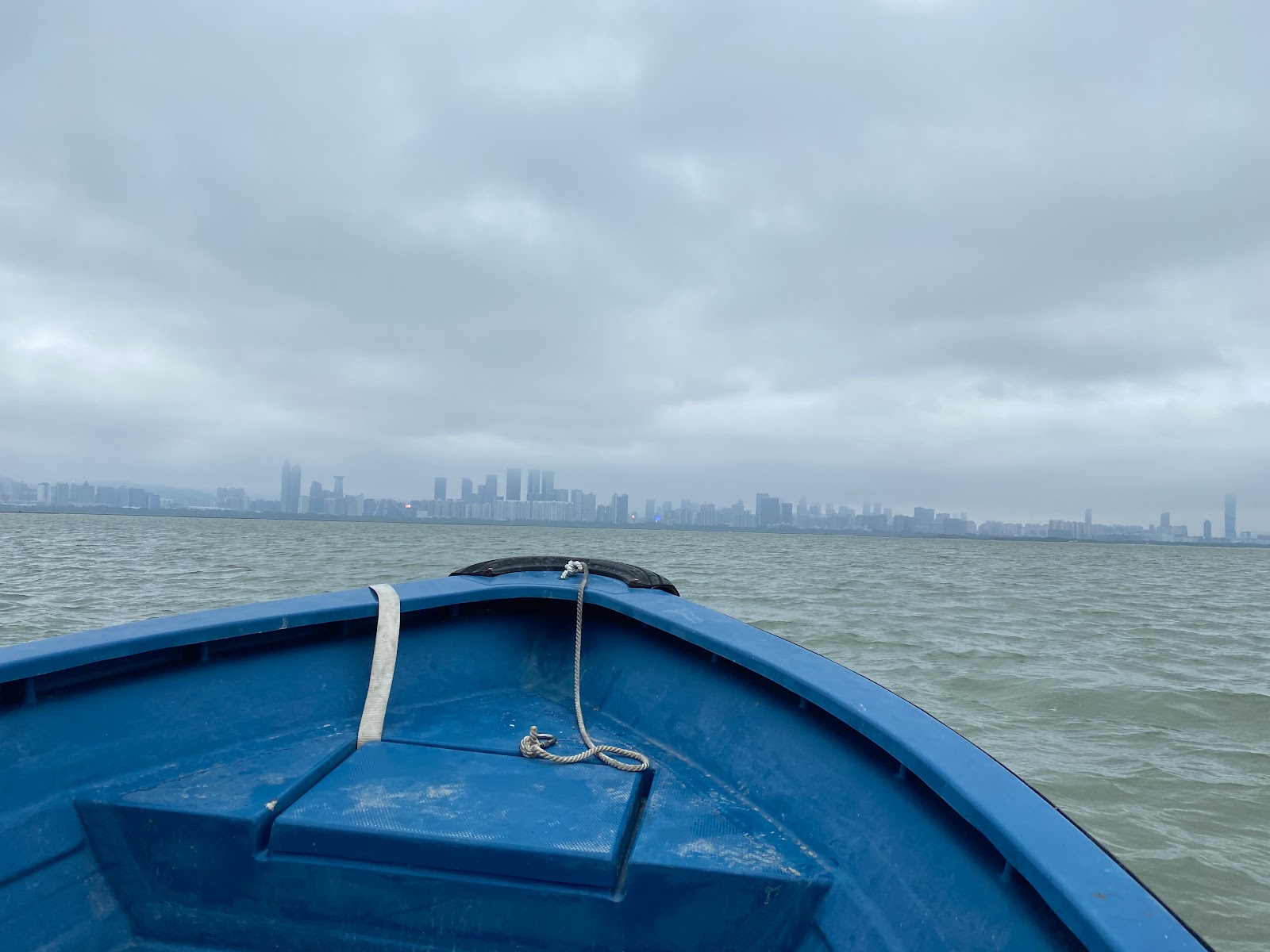
Since I started birding in Hong Kong years ago, Red-breasted Merganser had always been one of those birds that was supposed to be a regular wintering species in the Deep Bay area, their numbers dropped slowly until when I started birding seriously, there weren't really any around anymore. So, its been a species thats eluded my Hong Kong list for quite some time, adding to that I missed the only twitchable one at Lut Chau a few years back, so this was one of the species on my 'wanted list'. News of one found floating along with Greater Crested Grebes at Deep Bay was encouraging, I managed a distance scope view on Sunday, but when Captain suggested to get a boat to try get a closer view on Monday I thought it was an interesting proposition.
It was the first time I've ever been out to Deep Bay, it was an interesting experience to get close to the oyster farms. Weather was not particularly good, with darker clouds looming in the distance. It took us a while to finally locate the merganser amongst the Great Crested Grebes, and views were much better than that from ashore. To our surprise, it was extremely skittish, we were over 100m away when it took off and landed back onto the water much further away. We managed a few closer fly-by views and that was it, as the rain came in we knew this was as close as we could get to this bird. It was still a very satisfying experience to see this species in Hong Kong.
 |
| Red-breasted Merganser - female |
 |
| Red-breasted Merganser - female |
Great Crested Grebes were in no short supply, we saw plenty floating around. I didn't take a lot of photos of other birds seen out there, but we also saw lots of Black-headed Gulls, Grey Plovers, Kentish Plovers and hundreds of Cormorants.
 |
| Great Crested Grebe |
Fung Lok Wai is probably still the most productive area of late, with a good range of species for birders to find. It is a large area, so you may not see all the species in one visit. Many Great Cormorants are now moulting into their breeding plumage, like this one which is starting to get white specs on its head and neck. There were a good numbers of Barn Swallow around, I scanned for anything more interesting but had little luck, though being able to see them perched at closer range is still a wonderful experience.
 |
| Great Cormorant |
 |
| Barn Swallow |
The drake Greater Scaup been quite elusive, I managed a fly-by view of it though I never managed to see where it went in the end. Bluethroats are regularly sighted here, and quite a few inhabits the little tracks covered in tall grass. An Eastern Water Rail been frequenting the filthy gully just past the village houses, obviously the most perfect type of habitat for these reclusive birds! You can often find Chinese Penduline Tits around the reeds along the abandoned fish ponds.
 |
| Greater Scaup - male |
 |
| Bluethroat |
 |
| Eastern Water Rail |
 |
| Chinese Penduline Tit |
Fung Lok Wai is all about warblers this season, and most of them continue to show well, including the long staying Booted Warbler. At least two Manchurian Reed Warblers showed well, although not always easy to photograph. Some birders had luck with the Chiffchaffs again, but I've only been seeing Dusky Warblers since my last encounter with it. Finally, at least two Manchurian Bush Warblers often come out to the gutter to feed.
 |
| Booted Warbler |
 |
| Manchurian Reed Warbler |
 |
| Dusky Warbler |
 |
| Manchurian Bush Warbler |
Continuing with theme on warblers, I found a Pale-footed Bush Warbler singing at Liu Pok, I was actually looking for Golden-headed Cisticola that I have heard before in that area, but got this much rarer warbler instead! I've never been able to photograph this species in my previous encounters, and I missed the best chance to photograph one at Telford Gardens last year...So, I was particularly happy to get these respectable record shots of this skulker.
 |
| Pale-footed Bush Warbler |
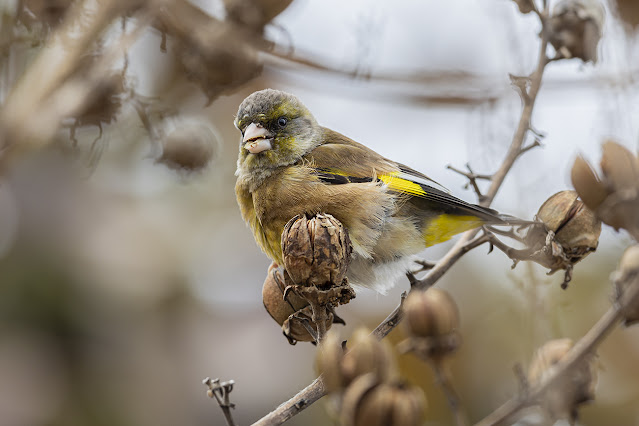
I've not been able to connect properly with the Oriental Greenfinches at Long Valley since last month, now after all the photographers are bored with them, I finally got around to see these charming little finches. These feeding on Crepe Myrtle seeds were not at all afraid of people, you can walk right past them and they would not fly off.
 |
| Oriental Greenfinch |
Over at Tai Mei Tuk Catchment, I didn't turn up anything new, but a very confiding juvenile Crested Goshawk was a nice encounter on a casual morning walk. The Grey-backed Shrike eluded me again recently but the Brown Shrike was more obliging to show itself.
 |
| Crested Goshawk - juvenile |
 |
| Brown Shrike |
Over at Wu Kau Tang, the Barred Cuckoo-doves continues to be the focal point for many visiting birders, although views were often difficult if not almost impossible! I was extremely fortunate to find this one perched on a few low branches of a tree on the opposite side of the valley, though far they were actually pretty good prolonged views.
 |
| Barred Cuckoo-dove |
The Fujian Niltavas and Small Niltavas both continued to show on and off, the Fujian Niltava was particularly elusive. I also found another Mugimaki Flycatcher in the area, this time a female, but again had been very difficult to even see clearly. I even had a singing Japanese Robin along the valley! But, it never showed and kept within the very thick undergrowth.
 |
| Fujian Niltava - male |
 |
| Small Niltava - male |
Wu Kau Tang is hosting a good collection of wintering warblers, including Pale-legged Leaf Warblers and Kloss's Leaf Warblers, though both of which I was unable to get a photo. The Greenish Warbler finally showed long enough for me to grab a record photo, while the Hartert's Leaf Warbler is often found in amongst the bird waves.
 |
| Greenish Warbler |
 |
| Hartert's Leaf Warbler |
The mistletoes outside the village attracted a few Scarlet-backed Flowerpeckers, the male was particularly showy and very confiding. I managed to get a few photos that I was very happy about, as I never seemed to be able to get a photo of the male with its signature back towards me.
 |
| Scarlet-backed Flowerpecker - male |