Showing posts with label Cinnamon Bittern. Show all posts

Monday, 24 January 2022

Productive January - Month of Warblers!

 Lately its been all about warblers, warblers of all sorts! I went on a hike from Wu Kau Tang to Sam A Tsuen with Hoiling last week, it is an area we rarely venture, and how very glad we went! Along the way I heard the distinctive call of an Alstrom's Warbler, and very soon we were looking at a very confiding individual, happily feeding just a few feet away from us. This was no doubt my best encounter with this species to date, even with just my 100-400mm lens delivered quite good results.


Alstrom's Warbler - very friendly individual

Also in the same area was a fruiting tree, and that attracted some thrushes, the most note worthy was a single Brown-headed Thrush, a species I never been able to photographed before! While this is no more than a record shot, still very pleased to have seen it, as this species is not at all common nowadays in Hong Kong.

Brown-headed Thrush - record shot

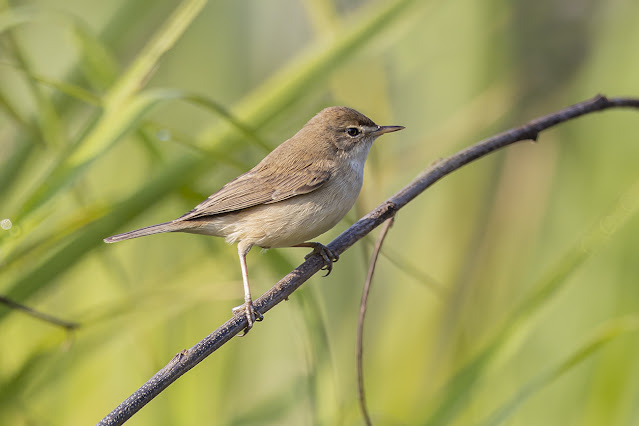
Over at Fung Lok Wai, a Booted Warbler was reported again lately, I believe this maybe the same individual seen late last year, but now moulted into much fresher plumage. It showed exceptionally well for me, as I was the only one there that morning I was able to enjoy prolonged views undisturbed, it was even singing, which I never quite imagined I would hear in Hong Kong!


Booted Warbler

Fung Lok Wai seems to be reed warbler heaven, with numerous Black-browed Reed Warblers wintering, I also saw an Oriental Reed Warbler amongst them. At least two Manchurian Reed Warblers were also seen, this species rarely winters in Hong Kong, but given the amount of reed warblers around the area I can't say I am at all surprised. This particular one was ringed from somewhere.

Manchurian Reed Warbler

The area also host a good selection of common species, including many singing Yellow-bellied Prinia, where this unusually warm January seems to have triggered them into song already. Dusky Warblers were in no short supplies, you very well may see one every ten metres along the fish ponds here.

Yellow-bellied Prinia

Dusky Warbler

Its always worth scanning for other warblers when you have a good number of one species, and you may just find something good amongst them. This was the case here at Fung Lok Wai, as it seems at least two Chiffchaffs have taken up residence here with the Dusky Warblers. They were not particularly easy to track down, but once you see it you can tell immediately that it is not a Dusky Warbler, simply by its more delicate looking dark bill, along with the black legs. The default Chiffchaffs we get in Hong Kong are Siberian Chiffchaffs, although potentially we may get Mountain Chiffchaffs as well, that is currently not on the Hong Kong list. While the best way to differentiate them should be by call, unfortunately the one I saw did not vocalise.

Chiffchaff - a rarity in Hong Kong

Other notable birds at Fung Lok Wai includes two Purple Herons, numerous Black-faced Buntings and a single Pacific Swift flying amongst the House Swifts.

Purple Heron

Black-faced Bunting

Pacific Swift

Over at Kadorie Farm, a male Thick-billed Green Pigeon was reported by KFBG staff. It was feeding on a Big-leaved Fig, it supposedly showed extremely well on Sunday. I went on Monday and fortunately caught up with it for a few minutes before it flew off and disappeared for the rest of the day! It seems that it finished all the nice figs and maybe moving onto other trees, while there were plenty of Superb Figs still in the area, it didn't seem to like them very much.


Thick-billed Green Pigeon - male

Closer to home at Tai Mei Tuk Catchment, the single male Bay Woodpecker stayed on in the area, this time I finally got some record shots of it. Despite not being very rare now, Bay Woodpeckers are super tricky to get photos of.


Bay Woodpecker - male

Another bird that stayed through this winter was the juvenile Grey-backed Shrike, and now its starting to moult into sub-adult plumage, it is much more apparent what it really is. This leads me to believe that many more juvenile Grey-backed Shrikes may have been overlooked in the past as Brown Shrikes. Hopefully with more being more confident in identifying juvenile Grey-backed Shrikes, we can really understand whether they are truly being under reported.


Grey-backed Shrike - assuming sub-adult plumage

I was hoping for Greenish or Hume's Warblers along the catchment, but only managed a few Two-barred Warblers along with the common Yellow-browed and Pallas's Warblers.

Two-barred Warbler

Finally, I managed to connect with the long staying Cinnamon Bittern at Tai Mei Tuk! Although I live very close-by, and I do check that particular pond regularly, I have not seen this individual throughout this winter despite several birders reported it. Turns out I was just very unlucky before, as this very confiding individual was out in the open as soon as I checked this pond after my morning walk at the catchment. I don't see adult like this right out in the open very often, so I was very glad to finally see it and get some nice photos to remember it by.


Cinnamon Bittern

Friday, 28 May 2021

Grey-headed Swamphen & Other Early Summer Birds

A Grey-headed Swamphen found by Bart earlier in the week at Fung Lok Wai finally got me to head back out in the field after nearly two weeks without any proper birding. It took my third try to finally see this bird, where it came out briefly just before sunset. Grey-headed Swamphen is not a particularly common species in the region, but they are found regularly at certain locations in Guangdong, so the odd ones often wanders to Hong Kong occasionally.


Grey-headed Swamphen

On the same pond a pair of Common Moorhens were rearing a few chicks, often coming out to the edge of the long grass to feed. One of the better species in the area were at least two Cinnamon Bitterns, the male perched briefly and flew through for great views, this species was found breeding in Wetland Park a few years back, so quite likely they will be breeding the area.

Common Moorhen with chick


Cinnamon Bittern - male

Chestnut-winged Cuckoo is easily my favourite cuckoo species in Hong Kong, with their outrageous crest and colourful wings. I was delighted to find a very confiding individual near home, where I was able to observe it up close.


Chestnut-winged Cuckoo

Things certainly quietened down at Tai Po Kau, with no Chinese Barbets or Collared Owlet calling. Other resident and breeding species still fairly active, although many now much harder to see as they are well into breeding. Plain Flowerpeckers are still fairly easily heard around the reserve, while Hainan Blue Flycatchers are not as vocal as before, but with a little effort you often still get rewarded by a singing male.

Plain Flowerpecker

Hainan Blue Flycatcher - male

The best species around was no doubt a pair of Brown-breasted Flycatcher, now with nest that housed four chicks. Despite being next to the main footpath, the nest sits above the stream, so hopefully it will be enough to protect the chicks until they fledge. The parents were busy hawking for insects along the stream and bringing them back to the chicks.


Brown-breasted Flycatcher

Brown-breasted Flycatcher - nest with chicks

Monday, 24 October 2016

Wet afternoon at Long Valley

Eurasian Skylark - mission accomplished in a way.

After Typhoon Haima, a rare visitor in mid October visited us on Friday, weather was in fact quite fine the day after. Although I did have work to do on the Saturday, so I thought it was best that I can at least free up a Sunday afternoon to do some birding. Seeing that many have had some good birds at Long Valley including a group of Eurasian Skylarks which I have yet to photograph in Hong Kong.

I invited Yuen whom gladly joined me for a short visit to Long Valley even though he already went the day before. We met up at Sheung Shui and took the minibus to Yin Kong Village. The weather didn't look good however, radar image from Hong Kong Observatory showed a rain cloud forming over Sheung Shui; right on top of where we were. Just as we got off and thought we could just make it before the rain sets in, it chucked down hard on us, completely soaking us...We rushed to the rain shelter at Yin Kong entrance and waited for nearly an hour before it cleared up.

First birds up were a few Pacific Golden Plover on a half flooded field, quite a nice change to see them at Long Valley, I usually see most in Mai Po. Zitting Cisticolas had gained in numbers and is now everywhere, one of them posed nicely in a paddy for a well composed photo.

Pacific Golden Plover

Zitting Cisticola

We saw a few Yellow-breasted Buntings but they were all very skittish. A pair of Turtle Doves on the wire was a pleasant sight, the Oriental Turtle Dove on the left and Red Turtle Dove on the right, giving a very nice size comparison between the two species, shame the Spotted Dove to the far right did not want to join in the group photo. Near Ho Sheung Heung side Yuen spotted a Flycatcher, a quick look revealed a Grey-streaked Flycatcher, busy hawking for insects after the heavy rain. Nearby we saw a Pheasant-tailed Jacana but this one did not want to show and flew off the moment it saw us.

Oriental Turtle Dove & Red Turtle Dove

Grey-streaked Flycatcher

At the field that the Eurasian Skylarks had been reported we found three remaining, all looking rather shabby after the rain. They were not as confiding as they were a few days ago, I guess had become less so after filling up their bellies! But they gave some rather distant but decent views. We do get Oriental Skylarks in Hong Kong, but rarer. Main feature to separate the two seems to be primary projection, with Oriental's being shorter. Oriental's tail should be shorter in flight as well as rounder wings. Bill size is another feature that many seems to have talked about, Oriental's being slightly larger and thicker. But, Lark identification have never been an easy task, without direct comparison in the field it can get quite confusing...But looking at the primary projection on these birds I think it's safe to call them Eurasian.

Eurasian Skylark - this one was clearly as wet as we were after the rain.


Eurasian Skylark - primary projection quite clear on this photo.

The Black-headed Bunting flew away before we got a good look, at least we spotted it...A pair of Oriental Reed Warblers were shy but gave us a full view after some persuasion. We both waited until quite late, hoping for any Amur Falcons dropping in...no luck on the day! Will have to try again later. We did however got a fly-by Cinnamon Bittern, this time I was able to snap a few shots before it disappeared into another field...really not a cooperative bird at all.

Oriental Reed Warbler

Cinnamon Bittern - when will you stop?