Day 3 - Doi Lang (Western Slope)
We had an early start at 4:30am to drive towards the western slope of Doi Lang, as we wanted to arrive at the Hume's Pheasant stakeout before sunrise. We arrived in complete darkness, and Ball helped pitched the portable bird hides on the side of the road. As it got brighter, birds started calling and a few White-browed Laughingthrushes appeared in front of our bird hide. They were soon joined by a few even noisier birds in form of Rusty-cheeked Scimitar Babbler.
White-browed Laughingthrush
Rusty-cheeked Scimitar Babbler
Soon after a few large birds emerged from the right hand side of the road, up to three female Hume's Pheasant came out onto the road to feed. Like all female pheasants they look quite plain at first glance, but their plumage are really quite beautiful when you are able to look closely at the delicate patterns.
Hume's Pheasant - female
It was most unfortunate that a car came past and spooked the pheasants back into the undergrowth...All was quiet except for a few Japanese Tits and Rufescent Prinias feeding in front of our bird hide.
Japanese Tit
Rufescent Prinia
It felt like forever, but after another 30 minutes, our patience paid off when a few female Hume's Pheasant walked out onto the road, and soon after a brilliant looking male Hume's Pheasant followed. It was extremely cautious at first, but after the females started feeding frantically on the road the male finally relaxed.
Hume's Pheasant - male, the star of the show!
Flock of Hume's Pheasant feeding on the road
At one point it disappeared into the left side, only to return a few minutes later and posed for us on the middle of the road. Bursts of shutters filled the morning air...
Hume's Pheasant - the photogenic male posing on the road
The pheasants soon had their fill and left, leaving the 'stage' open for other attractions, the most brilliant being a beautiful male Ultramarine Flycatcher, it was no doubt a show stopper and completely won me over.
Ultramarine Flycatcher - male
Other great birds were also present, although attracting a lot less attention, including a female Slaty-backed Flycatcher, a pair of Grey Bush Chats and a juvenile male Siberian Rubythroat.
Slaty-backed Flycatcher - female
Grey Bush Chat - male
Siberian Rubythroat - juvenile male
A Chestnut-vented Nuthatch also came by, along with a steady stream of White-browed Laughingthrush, which was no doubt the most common bird in the area.
Chestnut-vented Nuthatch
White-browed Laughingthrush
While the small birds danced around in front of us, four Mountain Bamboo Partridges materialised out of thin air further back! This being another one of my target species received it's fair shares of shutter counts. I find the patterning on these partridges subtly beautiful, the four birds were rather inconspicuous and stayed only shortly before disappearing into the undergrowth once more.
Mountain Bamboo Partridge
Having had a successful early morning run we left the bird hide in high spirit, I was so contented at that moment, that I wasn't quite ready for a Spot-breasted Parrotbill that jumped into view after a quick burst of playback by Ball. This incredible looking species possesses a wonderfully comical beak even amongst other parrotbills.
Spot-breasted Parrotbill
Ball drove us up to a stretch of road that connects to the border of Myanmar, the guard on duty is used to birders coming to this area. Here we saw a few Large Cuckooshrikes, small flock of Grey-chinned Minivets and many Flavescent Bulbuls. It was quiet overall, although we managed to spot a Bush Warbler of some kind skulking in the tall grass, which is most likely an Aberrant Bush Warbler. We also saw a Bunting species of some kind, although we were unable to relocate the bird once it flew into the tall grass. Davison's Leaf Warblers were extremely common here and their songs were heard continuously.
Overlooking towards Myanmar
Large Cuckooshrike
Grey-chinned Minivet - male
Flavescent Bulbul
Davison's Leaf Warbler
By that time it was mid-morning, and things had gone quiet. Ball suggested that we visit some of the feeding stations. Bird photographers had setup various stakeouts and feeding stations along a patch of moist forest over the years, and these spots attracts plenty of birds to visit every year, some species even returning on an annual basis. The most common species here were again Flavescent Bulbuls and White-browed Laughingthrushes.
Flavescent Bulbul
White-browed Laughingthrush
At the first stakeout we added a White-gorgeted Flycatcher and a male Slaty-blue Flycatcher, both were lifers for me. Although a male Rufous-gorgeted Flycatcher was the most dominant of the three species, constantly fighting for the best feeding spots.
White-gorgeted Flycatcher
Slaty-blue Flycatcher - male
Rufous-gorgeted Flycatcher - male
At another stakeout, a female Slaty-blue Flycatcher was present, it was however rather shy, only coming out to feed sparingly, and always lightning quick when it did. A few Silver-eared Laughingthrushes were however far more cooperative.
Slaty-blue Flycatcher - female
Silver-eared Laughingthrush
The male White-bellied Redstart never showed at the stakeout, so we decided to have lunch first before walking around to look for birds along the road. There are no amenities of any kind at Doi Lang, therefore birders will need to prepare your own food and drinks. After lunch things started off pretty well, with a male Chestnut-bellied Rock Thrush, a Slender-billed Oriole and a few Short-billed Minivets also made an appearance.
Chestnut-bellied Rock Thrush - male
Slender-billed Oriole - male
Short-billed Minivet - male
A male Orange-bellied Leafbird and a few Yunnan Fulvettas were not as exciting as a Hume's Treecreeper which came out of nowhere! I also spotted a beautiful Golden-throated Barbet, which was our first sighting after two days of 'heard only'.
Orange-bellied Leafbird - male
Yunnan Fulvetta
Hume's Treecreeper
Golden-throated Barbet
With no signs of Himalayan Cutias, we decided to head back to the stakeout to wait around for the White-bellied Redstart. For an hour we only saw glimpses of the bird, hopping around and calling in the undergrowth, while many Rusty-cheeked Scimitar Babblers came and gone. We were getting increasingly impatient for the Redstart, especially when two Giant Nuthatches flew over our heads...It finally revealed itself properly after a gruelling wait, although I must admit it is quite a stunning looking bird when it decided to appear.
Rusty-cheeked Scimitar Babbler
White-bellied Redstart - male
It was getting darker by the minute and we wanted to make use of the remaining sunlight to look for Giant Nuthatches and Himalayan Cutias. We added Black-throated Tits nearby and later a pair of Grey-capped Pygmy Woodpeckers. A male Siberian Rubythroat perched out in the open on the side of the road was quite a nice surprise.
Black-throated Tit
Grey-capped Pygmy Woodpecker
Siberian Rubythroat - male
It was already past 6pm when Ball heard the call of Himalayan Cutias, I searched extremely hard for them but had no luck, a Stripe-breasted Woodpecker and a large flock of Grey-headed Parrotbills ended our day. Although slightly disappointed about the Cutia, Ball stated that we will get another chance the day after when we can return here for a cleanup.
Stripe-breasted Woodpecker - female
Grey-headed Parrotbill
Day 4 - Doi Lang (Eastern Slope)
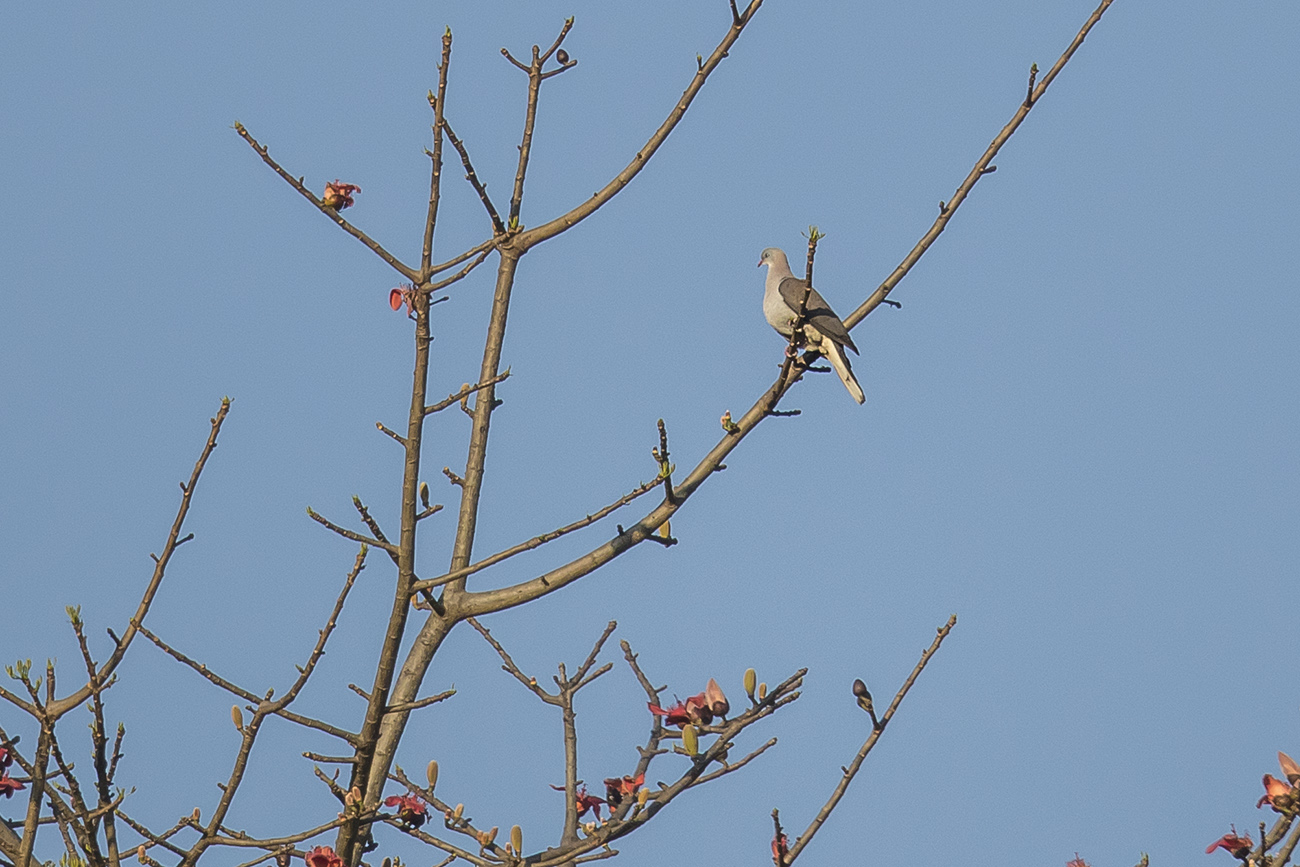
It was yet another early start, Ball had booked an open backed jeep for the journey up this side of Doi Lang, as the roads are much rougher here. We got through the check point and stopped at the concrete bridge to look for some birds in the early hours. It was quite productive there and we yielded quite a few species, including Barred Cuckoo-dove, Collared Babbler and White-necked Laughingthrush to name a few, but none of which allowed a photo record. A Streaked Spiderhunter came along with a flock of Striated Yuhinas. While an Orange-bellied Leafbird also made an appearance, as did a Lesser Racket-tailed Drongo. Several Mountain Imperial Pigeons flew past but one perched on top of the bombax tree for a better look.
Streaked Spiderhunter
Orange-bellied Leafbird - male
Lesser Racket-tailed Drongo
Mountain Imperial Pigeon
We arrived at the Border Police Check Point, which is quite a popular birding spot at Doi Lang, as the police had put out rice and fruits for the birds on a daily regular basis, attracting many species here. We were quickly greeted by flocks of Silver-eared Laughingthrushes, as well as the beautiful Scarlet-faced Liocichla. Black-backed Sibias were also very active here.
Silver-eared Laughingthrush
Scarlet-faced Liocichla
Black-backed Sibia
Our attention shifted to another feeding spot, where a few absolutely stunning Spectacled Barwings made their grand entrance. Soon after more Scarlet-faced Liocichla followed, as well as even more Black-backed Sibias...
Spectacled Barwing
Rufous-faced Liocichla
Black-backed Sibia
Around the same area a male Large Niltava made an appearance and was extremely photogenic, while a few Whiskered Yuhinas showed very briefly, I was just quick enough to grab a few record shots before they disappeared.
Large Niltava - male
Whiskered Yuhina
We walked further down the slope to find a small feeding flock, consisting of a few Black-eared Shrike-babblers. Short-billed Minivets also made an appearance with the flock.
Black-eared Shrike-babbler
Short-billed Minivet
There were many warblers within the flock, none of which provided particularly good views, but I was able to grab a shot of this particular one which I think maybe a Chinese Leaf Warbler.
Chinese Leaf Warbler
Further along we found a Davison's Leaf Warbler feeding at eye-levels, a great opportunity to observe this species closely. This is by far the most common species in the area, their cheerful song is diagnostic.
Davison's Leaf Warbler
A male White-tailed Robin came to the feeding station looking for food, while a female Himalayan Bluetail also came in, just in good time as a tour led by Uthai Treesucon came along, Uthai is one of the author of the Lynx "Birds of Thailand". So we decided to move on somewhere else for other birds.
White-tailed Robin - male
Himalayan Bluetail - female
We drove up to the San Ju View Point, where Ball stated as an area sometimes good for wintering thrushes, and also good place to scan for raptors. We only yielded a male Red-flanked Bluetail for our effort but Ball stated this is less common than the Himalayan Bluetail in northern Thailand, although I would have much preferred the latter. We had lunch at the view point, and sure enough a Mountain Hawk Eagle drifted past.
Red-flanked Bluetail - male
Mountain Hawk Eagle
After lunch we returned once again to the police check point, a mixed flock provided good views of a pair of Blyth's Shrike-babbler, a species you hear constantly but good views are hard to come by.
Blyth's Shrike-babbler - male & female
We walked down into the valley where a Snowy-browed Flycatcher supposedly resides, the flycatcher only gave brief views, but the area was alive with birds, including a few Yellow-bellied Fantail, Chestnut-crowned Warbler, Rufous-winged Fulvettas, Golden Babblers and Yellow-cheeked Tits. While Slaty-bellied Tesia was heard only.
Yellow-bellied Fantail
Chestnut-crowned Warbler
Rufous-winged Fulvetta
Golden Babbler
Yellow-cheeked Tit - male
Back out along the main road we saw yet more Davison's Leaf Warblers and Yellow-bellied Fantail, while Spectacled Barwings again attracted plenty of attention.
Davison's Leaf Warbler
Yellow-bellied Fantail
Spectacled Barwing
Things quietened down in the afternoon, several small mixed flock came through but we added nothing majoring exciting, a Pallas's Squirrel also came by. A few Short-billed Minivets provided slightly better views than before.
Pallas's Squirrel
Short-billed Minivet
Two subspecies of the Blue Whistling Thrush can be found in Thailand, including the yellow billed of race eugenei and the black billed of race caeruleus. To me the yellow billed individuals looked extremely different to the black billed ones, they are also larger in size. In the same area we also found a pair of Little Pied Flycatchers, the female was especially photogenic.
Blue Whistling Thrush - race eugenei
Little Pied Flycatcher - female
At a fruiting tree we were able to add Striated Bulbul, which in my opinion is one of the most beautiful bulbuls out there, although the Crested Finchbill is probably not far behind. We added very little afterwards, so we decided it was time to head back to town.
Striated Bulbul
Crested Finchbill
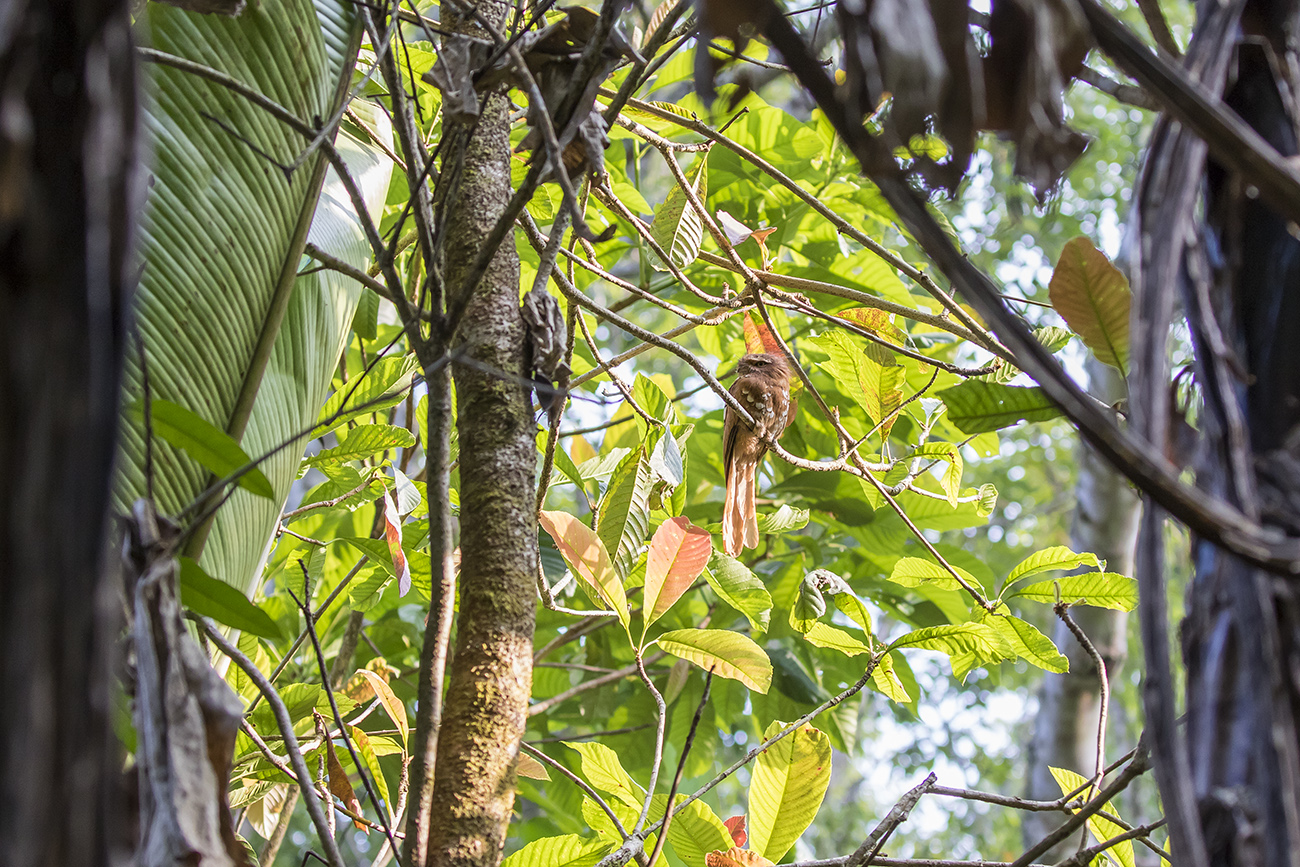
On our way down we met with Uthai's group again, as we were waving at them they told us to stop the car, all I heard was "Frogmouth", and the next thing I knew everyone was out of the car! Turns out Uthai had located a female Hodgson's Frogmouth at it's day roost, which is not a common sight at all! As most birders come to look for this species in March to April when they are nesting, only males sit at the nest, so we never had high hopes for this species on this trip, let alone a female! Therefore making this an extremely pleasant surprise for all of us!
Habitat shot of the Hodgson's Frogmouth
Hodgson's Frogmouth - female
We stopped briefly at the Hill Tribe Rice Fields, there we added a very distant Rufous-winged Buzzard, a few Striated Swallows, Siberian Stonechats, Paddyfield Pipits and Chinese Pond Herons.
Rufous-winged Buzzard
Striated Swallow
Siberian Stonechat - female
Paddyfield Pipit
Chinese Pond Heron
Everything after the Frogmouth was a bit of an anti-climax, including a few Red Jungle Fowls by the side of the road, only the female stopped long enough for me to get a photo. A female Asian Fairy Bluebird was our last bird of the day.
Red Junglefowl - female
Asian Fairy Bluebird - female