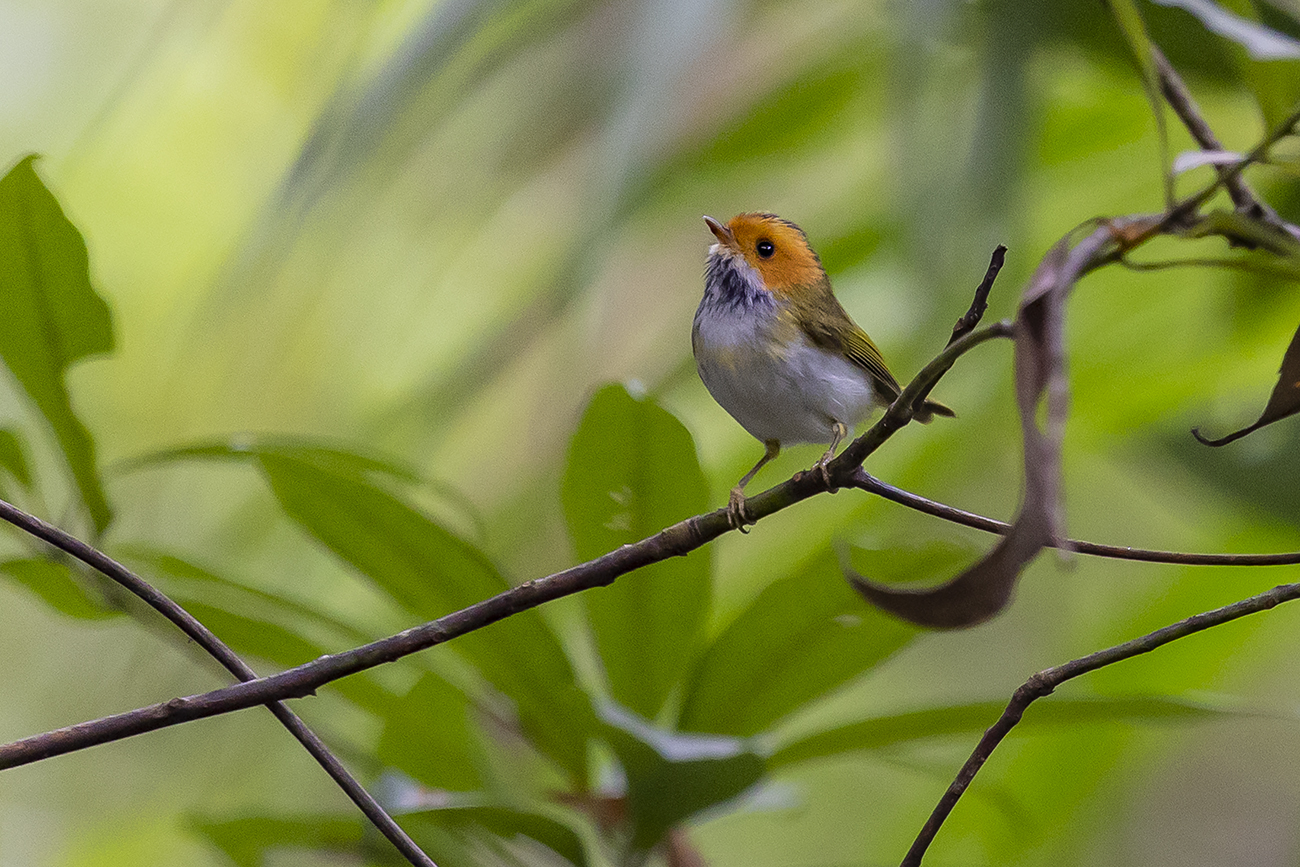
Our second attempt for the long staying Black-chinned Yuhina was successful, it arrived on a fruiting Schefflera heptaphylla or Ivy Tree like clockwork at around 3pm. It was feeding intermittently on the tree with a few Swinhoe's White-eyes during a half hour window, but showed beautifully while it was there. Whether this record will be accepted by the RC remains to be seen, but I don't see no reason why this vagrant couldn't have followed the wrong flock of Indochinese Yuhinas or White-eyes and ended up in Hong Kong, it certainly looks to be in very good conditions. The Ivy Trees also attracted other birds such as bulbuls and a few Yellow-cheeked Tits.
 |
| Black-chinned Yuhina - 1st record for Hong Kong |
 |
| Yellow-cheeked Tit - male |
I haven't been to Long Valley for a while, and with the ongoing construction of the 'nature park', things are not quite the same as they used to be, bulldozers and lorries are now a regular sight along the fields, with various concrete structures erected at various locations. Whether this will affect the birds in the long run remains to be seen, my concern is that constructers re-landscape everything first and making the once fertile wetland into a man-made wetland. If it becomes something like Wetland Park (Which I truly hope not), we maybe in trouble...
 |
| I am guessing a toilet block of some sort? |
The only birds that seems to be happy about the bulldozers seems to be the Eastern Cattle Egrets, which were following these metal beasts, hoping to feed on anything turned up in the soil by them.
 |
| Eastern Cattle Egret |
A flock of Eastern Yellow Wagtails had me scanning for Citrine Wagtails, just when I thought I got one with the 'C-shaped' ear coverts, something about this individual didn't look quite right for me, it wasn't as 'grey-toned' as I expected, but ear coverts were yellow and its lores were quite pale. Head wasn't particular yellow so that was no help. Wing-bars were useless in this case as it was moulting and both median and greater coverts were very worned. Back was showing some tint of olive. So, is this a Citrine or Eastern Yellow Wagtail (race taivana)?


 |
Citrine Wagtail - I will put it as that for now, happy to be corrected
I dug up some old photos of various supposed Citrine Wagtails I photographed, and this individual from spring 2010 certainly was even more peculiar than my bird, but very yellow ear coverts and a supercilium as well as pale lore doesn't quite fit regular taivana Eastern Yellow Wagtail. What are these? Maybe some taivana can show these features during moult?
Citrine Wagtail / Eastern Yellow Wagtail? - from spring 2010 |
Despite all the constructions, many common residents still seemed happy to hang out in the remaining fields. Here are several species which you are guarantee to see at Long Valley, White-breasted Waterhen, Wood Sandpiper, Siberian Stonechat, Plain Prinia and of course the fabulous looking Greater Painted Snipe.
 |
| White-breasted Waterhen |
 |
| Wood Sandpiper |
 |
| Siberian Stonechat |
 |
| Plain Prinia |
 |
| Greater Painted Snipe |
On a wet muddy field, quite a few hirundines were collecting mud for their nests, including numerous Barn Swallows, but also the larger Red-rumped Swallows. This species is a less common breeding species in Hong Kong, I observed at least 3 pairs carrying mud away from this site.
 |
| Barn Swallow |
 |
| Red-rumped Swallow |
While this was not a particularly good time for buntings, I found two species, including a Little Bunting and a very pretty looking Chestnut-eared Bunting, on closer inspection this was a ringed individual, likely by HKBWS.
 |
| Little Bunting |
 |
| Chestnut-eared Bunting |
The numerous Chestnut and White-headed Munias were still around, there were actually more of them than Scaly-breasted Munias. My guess is that they will likely start breeding and spread in Hong Kong.
 |
| Chestnut Munia |
 |
| White-headed Munia |
The best bird at Long Valley was however a very confiding Common Starling, this was the closest I've ever been with a Common Starling in Hong Kong. I never quite appreciated them when I used to see them every day in the UK, but they are truly magnificent looking birds when seen up close with their iridescent plumage.
 |
| Common Starling |