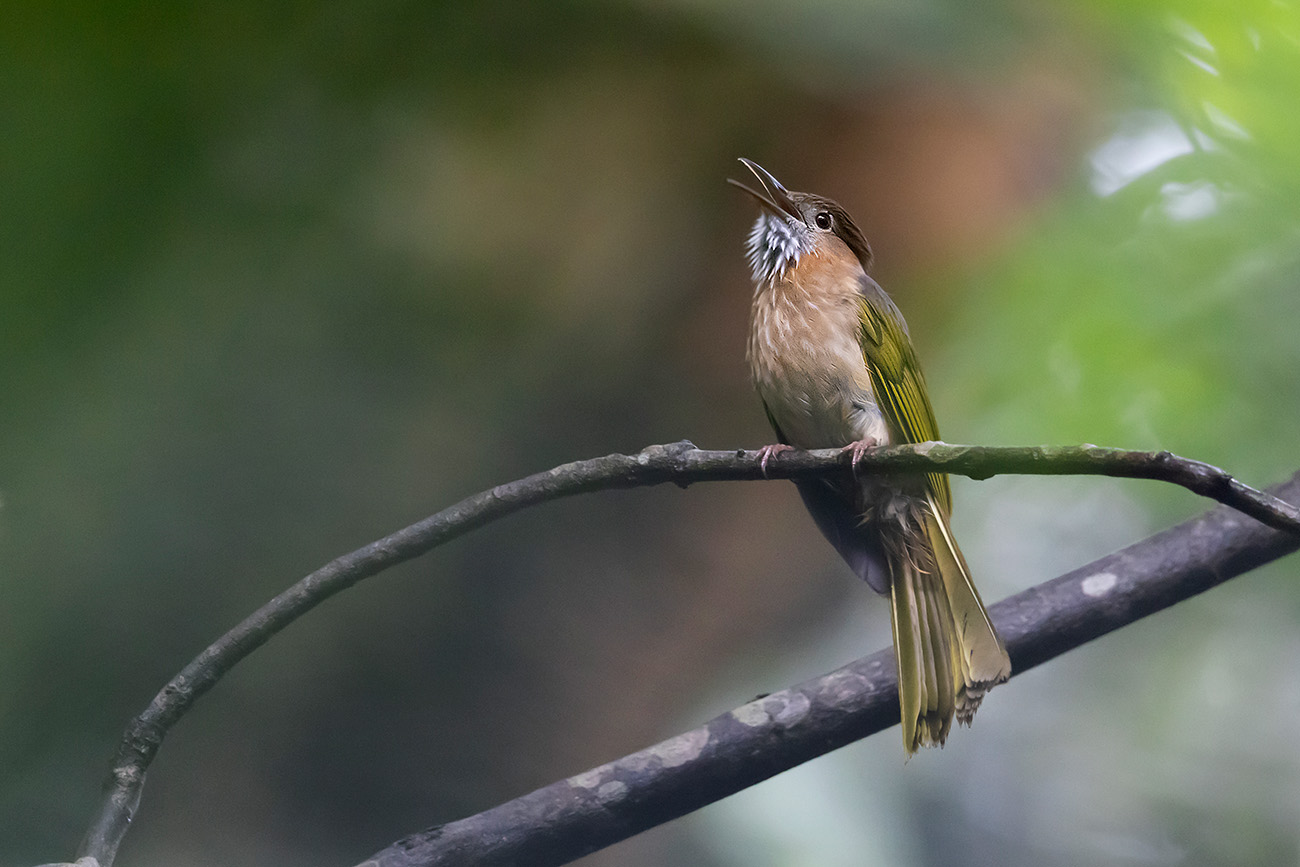
Canon revealed a new lens not too long ago, a much anticipated 200-800mm lens, a zoom range that seems too good to be true! As we all know, birds are generally quite small, therefore the longer the focal length, the better! Coming in rather compact and light, weighing at a mere 2.05kg, this lens is light enough to be carried around for hand held shooting. My Dad's been using the RF 800mm F11 for a while, and he's been enjoying the light weight aspect of that super telephoto lens, but that lens while great for its price range, lacks flexibility of a zoom lens, and quite often you will miss some shots simply because a bird comes a bit too close to you! The RF 200-800mm seems to be the answer to that problem. Plus, with a price tag of under 17,000HKD, it seems to be quite the bargain! My dad pre-ordered one in Hong Kong but was unable to take it home with him before it delivered, therefore, I get to try it out first...And here are my thoughts on this lens after using it extensively for a few days in different scenarios and habitats.
First, let's start with the overall design of the lens, it feels very well built, while the coating is different from the L-series, it doesn't feel cheap at all. The lens is by no means small, especially when extended fully to 800mm the lens alone measures at over 50cm. But, considering its range, it is very compact. The barrel design feels quite sturdy, perhaps a little too sturdy, as you need to put some effort in twisting it to get it to zoom in and out, I certainly cannot do it in one go! Otherwise, I find the design to be quite sleek, although I would prefer a lens with interior zoom, I can understand why Canon chose to have this as a barrel zoom design, to save cost and weight.
 |
| RF 200-800 F6.3-9 IS USM - Lens hood reversed at 200mm |
 |
| RF 200-800 F6.3-9 IS USM - Fully Extended |
Now, let's start with sharpness. Most people would compare this lens to the RF 100-500mm F4.5-7.1 IS USM, but looking at the retail price point, and the fact that the RF 200-800mm is not an L-series lens, you know there is going to be some differences in the quality. I am not saying the sharpness of the lens is bad, but when you do compare the photos taken with the two lens, you can obviously tell that one is much softer than the other, and you won't get that crisp edge that you would expect on the RF 100-500mm. Here's a fairly close Common Kingfisher in good light, the second image is a 100% crop, this photo have not been edited with AI denoise, so you can see how the lens actually performs. Here also, I had Richard's Pipit very close to my car, I was able to get a few shots before it flew off, again in good light. While overall the images are sharp, it is relatively soft on the edges, especially the details on the feathers, although with a bit of post editing and bit more sharpening, the results are still very respectable.

 |
| Common Kingfisher - 100% Crop |
 |
| Richard's Pipit |
Most of the time, I was maximising on the full focal length of this lens, which I am sure would be how this lens will be used most of the time. Having a handy 800mm with you gives you a lot of advantages, such as bringing your subjects closer. Here, I found a Golden-headed Cisticola, a small bird that was on the other side of the small water channel, having 800mm means the bird was still relatively 'big' on screen, I only needed to crop slightly to get the final result, which would have been too far for my 100-500mm to get any usable images.
 |
| Golden-headed Cisticola |
As expected, this lens was able to capture quite a lot of details in good light, such as this friendly Amur Stonechat. I was pleasantly surprise that it actually does pretty well even of birds perched in the shade, such as this male Daurian Redstart, as you can see, the feather details on the orange belly rendered quite well.
 |
| Amur Stonechat - male |
 |
| Daurian Redstart - male |
I really put the lens to the test when I took it into the dark forest of Tai Po Kau, conditions like this is a challenge to any lens, being an F9 at 800mm, this is not a lens you would consider a bright lens. I was pleasantly surprise that autofocus still works relatively well considering how dark it was. With these smaller aperture lens, I often have to crank the ISO up higher, these photos were taken with ISO 6400 and ISO 5000, shutter speed for both photos at 1/160. At such slow shutter speed together with such a long focal length, it is no surprise that it is not an easy task to get sharp images, thanks to image stabiliser your odds of getting a sharp image is definitely much higher. The higher ISO is also not too much of a problem nowadays, as long as you have a sharp image to start with, AI Denoise can often help clean up the photo in post editing. The Yellow-cheeked Tit photo also shows if your subject is at a reasonably close range and your background is further away, you can still create quite a nice blurred background with this F9 lens.
 |
| Yellow-cheeked Tit - ISO 6400 1/160 F9 with PS AI Denoise |
 |
| Huet's Fulvetta - ISO 5000 1/160 F9 with PS AI Denoise |
Another way to achieve a nice blurred background with this lens is to know where to put your lens when taking photos. By getting as close to eye-level with your subject, you can still get nice subject separation from the background. Such as the long staying Great Crested Grebe at Tai Sang Wai, which provided perfect opportunity to test this out, while you are not going to get that super nice bokeh of a large aperture lens, getting lower down definitely helps. If your subject is even closer to you like this Black-headed Gull, the results can still be quite pleasing. You can also try to do some different composition with foreground, like this White Wagtail shot, which will give you a much 'cleaner' outcome. Same goes with this lovely Citrine Wagtail shot.
 |
| Great Crested Grebe |
 |
| Black-headed Gull |
 |
| White Wagtail |
 |
| Citrine Wagtail |
The Common Gull at San Tin have decided to stay on for a couple more days, which gave me another opportunity to get some better images of this rarity. It was quite active, which allowed me to test some BIF shots. I was overall quite pleased with the results, my EOS R6 mkii paired up quite nicely with the RF 200-800mm, and tracking this flying gull was far less challenging than taking photos of those forest birds, and the lens handled it quite nicely.
 |
| Common Gull |
While most people probably would be using this lens mostly on the longer end of the focal length, having the ability and flexibility to zoom out can be useful, for example when you wish to capture a scene with many birds, this allow you to be more creative and versatile with your composition, not that these photos below are good in any way, these are simply for demonstration of the versatility of this lens.
There are a few shortcomings on this lens that you should consider, for example heat haze does affect the image quality a lot more on this lens it seems, which is not particularly surprising for me since at 800mm you are often taking photos of things even further away, but there's just something about the lens that seems to magnify the effects of the heat haze. Here are two examples which no matter how much I tried, I simply couldn't get any crisp photos.
 |
| Black-faced Spoonbill |
 |
| Buff-bellied Pipit |
It is also important to note that vignetting can be quite obvious, especially on light coloured backgrounds, here is a Black-faced Spoonbill photo with the sky as background without any crop, although this can also be fixed in post editing. The corners are also not very sharp as expected, this may not be too much of a problem as most of the time you will be cropping the image slightly anyway for wildlife or bird photography, although if you have a photo where you don't need cropping, the results can be a bit more noticeable, like the Crested Myna on the edge of this photo of the long staying Daurian Jackdaw.
 |
| Black-faced Spoonbill - vignetting on the corners |
 |
| Daurian Jackdaw - some distortion on the corners |
This lens is compatible with the 1.4x and 2x teleconverter, which will give you a whopping 1120mm and 1600mm. I personally don't own the RF 2x teleconverter, I only have the 1.4x, and naturally I wanted to see how the RF 200-800mm work with it on. Firstly, it is nice that the AF area was not restricted and you still get the full range of AF points with the 1.4x teleconverter. AF still works well and was able to do some tracking nicely. But, at F13 wide open I probably would only use this combination on very bright days. Here's a 100% crop of this Northern Shoveler, the image definitely looks much softer when you zoom in, so if you are looking for pin-sharp images, this combination is probably not for you. That being said, it does make this already versatile lens even more versatile, you can get much tighter composition on site without having to crop afterwards, and still get reasonably sharp images, if used in the right conditions, I think this combo still have some merits.

 |
| Northern Shoveler - 100% crop |
 |
| Northern Shoveler - with RF 1.4x Teleconverter |
Finally, is this lens quick enough to handle fast objects? A Peregrine Falcon that flew out from nowhere the other day was the perfect test subject! Of the 58 images I took from the moment I locked onto the bird with the bird eye tracking, all the 58 images were in focus. Almost at the same moment the Peregrine flew past me, a Northern Sparrowhawk came right by, this time slower but against the light, the lens still gave fairly good results and I was able to capture all the details on the underside of this sparrowhawk.
 |
| Peregrine Falcon |
 |
| Northern Sparrowhawk |
So, would I think about replacing my RF 100-500mm with this lens? The answer is probably not, even though I always wish I have more reach with my RF 100-500mm, the overall superior sharpness is a no brainer for me, I can trust that lens to deliver pin sharp images for me that will still look good even when I do a heavier crop. But, am I happy with the RF 200-800mm? I would say I am, considering the price range of this lens and the quality and performance it delivers, I would say this is quite the bargain. Being so light weight for its size is also something that is quite unique to this lens, which I think is a huge draw for bird photographers who enjoy walking around a lot. If you are thinking of upgrading to the EOS R system, this maybe the perfect starting lens! For RF 800mm F11 users, this would be quite a tempting upgrade and would certainly give more versatility in terms of the subjects you can photograph. Overall, I would say Canon did quite a good job with this lens, although I would still have preferred a 200-600mm at F6.3 or even F7.1...
 |
| Pied Kingfisher |