Showing posts with label Buff-bellied Pipit. Show all posts

Tuesday, 10 November 2020

Deja Vu - Rosy Pipit...Again!

Rosy Pipit - Again!

It was a typical afternoon at Long Valley, November is always a good time to visit as you usually can end up with quite a good range of species, including various Buntings etc. Upon arrival I immediately picked up several Yellow-breasted Buntings feeding in the paddies. I later saw a single female Rustic Bunting as well, although it did not stay still for a photo, while the long staying Black-headed Bunting is still around. One of the more interesting bird I saw was a male House Sparrow, they are still considered a rarity in Hong Kong, this species is likely expanding its range from the west, and they are now regularly recorded during the winter months.
Yellow-breasted Bunting

House Sparrow - male

I met Benjamin who saw a Buff-bellied Pipit in another field, so I decided to head over to take a look, along with fellow birders Mike Leven and Sam Baxter-Bray. As we were approaching the field, I explained to Sam that this was the exact same field I found a Rosy Pipit in 2017. We scanned for pipits in the field and soon picked up a pair, one was clearly a Buff-bellied Pipit, with typical dark coloured mantle that is faintly streaked.

Buff-bellied Pipit

The other bird however caught my attention, it was very well marked with streaked mantle, finer streakings on the breast compared with the Buff-bellied, plus a much more pronounce eyebrow. At that point various possibilities ran through my head, and this bird felt strangely familiar to me, on closer inspection I noticed the olive coloured edges to the primaries and tertiaries, and it clicked. A Rosy Pipit! This was surely a Deja Vu, what were the chances that I found yet another Rosy on the exact same field!? I asked Mike for a confirmation on this, and after a few minutes of observation, we both agreed this should be a Rosy Pipit in non-breeding plumage.

Rosy Pipit - pronounce eyebrow, streaked mantle and olive edges on primaries and tertiaries

We had great views of the bird for the next thirty minutes or so, before it flew off to another field. To my knowledge it was seen again the next morning, but a photo of a cat with a pipit had everyone believing the Rosy may have met its demise...Although some believe it was a Red-throated and not the Rosy, either way, feral cats is a huge problem for migratory birds.

Rosy Pipit

 At one of the overgrown ponds, an Eastern Water Rail had been fairly regularly making an appearance, I had a quick look before dark and saw it strutting along the edge. A Slaty-breasted Rail is also supposed to be present, although I didn't get to see it. A few Greater Painted Snipes were also at the same pond, coming out into the open at dusk.

Eastern Water Rail

Greater Painted Snipe - female

It had became a habit of mine to check in on Telford Gardens every so often in between jobs. While the long staying Middendorff's Gropper is still present, I was lucky enough to see this extremely confiding Lanceolated Warbler on my last visit, it was the most cooperative one I have ever seen, strolling along the flowerbed looking for food. I have always had a soft spot for this species, being quite a dainty bird compared with other grasshopper warblers, I find their streaking to be quite beautiful.


Lanceolated Warbler - so very friendly!

Saturday, 26 March 2016

A Very Good Friday

Spring is upon us, although the weather was not typically what we would expect it to be at this time of the year. It was however quite pleasant, not too humid with a hint of wintery chills that have lingered for longer then expected. But, as I always say, birds don't lie. Koels and Large Hawk Cuckoos have all started calling, while our glorious spring migrants have started to descend upon our humble city. Flycatchers are very typical migrants, and the Narcissus Flycatcher is one of them. A beauty as it's name suggest that always attracts the attention of birders and photographers alike, I never quite know whether the name suggests it's personality or that it's colour is similar to the Narcissus plant, but I guess if I look as good as they are I would constantly look at my own reflection too.

Narcissus Flycatcher - when you see them you know it's Spring

While I was pondering about where to go after the Good Friday church service, I received a message from Benjiman Li that he was photographing a male Narcissus at Ho Man Tin Service Reservoir Playground. My Father and I were there as quickly as we could. We arrived in good time, the bird was showing well and we had a blast of a time enjoying this stunner!


Narcissus Flycatcher - you can just glimpse the patch of greenish feather on it's head

Soon more arrived and a stake out point was setup by the photographers, the bird reacted immediately and went for all the meal worms he saw, even those on the ground...migrants have big appetites. The small patch of greenish feather on it's head indicate that this is a young male.


Narcissus Flyatcher

Birds are extremely opportunistic when given the chance...joining in with the feast provided were some long staying winter visitors, including a Taiga Flycatcher, could be the one that I saw at approximately the same location a few months ago. A female Daurian Redstart also came around for some easy pickings, she was most unpleased to find so many other birds feeding on "it's premises". Ho Man Tin Service Reservoir Playground is an incredible location, although surrounded by urban landscape, this oasis is a refuge for many migrants. It's likely that birds flying into Kowloon Peninsular see this large green "island" as an ideal place to land, being a very compact site, birds that cluster here are relatively easy to find, which may explain the large amount of rare sightings from this location.

Taiga Flycatcher

Daurian Redstart - bossing everyone around constantly

After that, we hit up Long Valley in hope that some migrants had dropped in. We were not disappointed. First up was a Red-necked Phalarope that swam around the flooded paddies, their feeding behaviour can be describe as "cute", where they do little circles while picking on the surface. You see most of them migrating out at sea, while a few get blown inland into places like Long Valley.

Red-necked Phalarope

Red-throated Pipits were everywhere, their faces now blushing as they get ready for their breeding season. You can pick them out much more easily from the fields now that they have changed colours. Amongst a flock I saw a single Buff-bellied Pipit, also starting to moult into breeding plumage. Note the fresh buffish colours on it's belly, hence the name.

Red-throated Pipit - blushing

Buff-bellied Pipit - moulting into breeding plumage

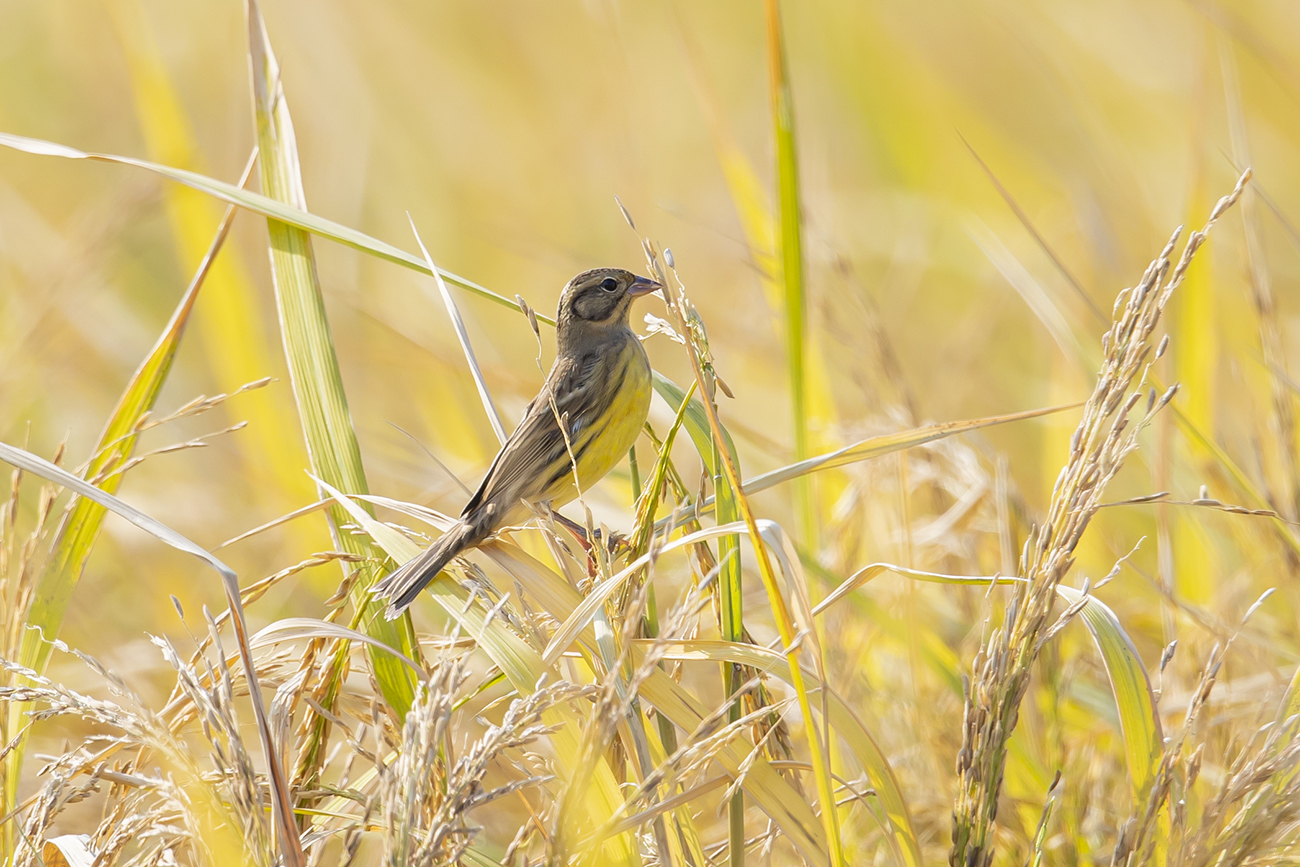
A very big surprise and no doubt our star bird of the day was not one, but TWO Japanese Yellow Buntings! They were found near Yin Kong Village, where they were found foraging with the Red-throated Pipits. This scarce Bunting is largely a spring migrant in Hong Kong, with a few reports each year. Their breeding range is limited to central and southern Japan, wintering as far south as the Philippines. Listed as vulnerable, the population trend of this species is on decline in recent years. This is a fairly early spring record, their numbers should peak around early April. It had been a good few years since I last saw this species, so it was nice to refresh my memory!


Japanese Yellow Bunting - our birds of the day!

Shortly after we found another Bunting, this time a Chestnut-eared Bunting. This one probably had been around all winter. It's also moulting into breeding plumage, getting more brightly coloured by the day!


Chestnut-eared Bunting

Last but not least, we saw more then a dozen Oriental Pratincoles towards the Ho Sheung Heung side. All lined up on the field, resting their wings from their long journey from South East Asia. We regularly see these strong flyers while out at sea during migration season. It's good to see one of my favourite bird again, their graceful elegance is always delighting.


Oriental Pratincole - very abundant at the moment

I got work tomorrow, so I probably won't be out again until Sunday afternoon. Hopefully I won't miss too much.

Saturday, 7 February 2015

Identifying Pipits

Decided to go somewhere a bit different this morning and headed to Ng Tung Chai, a valley near Lam Tsuen. The area was quite popular a few years back, but have since been a bit quieter and gotten less attention. However, this place have turned up many rarities in the past and certainly worth the steep hike up. Habitat is typical of Hong Kong's woodlands, but the steep valley makes it something different to Tai Po Kau.

Picked up Long Long at 6am and started the walk at 7am, walk up was pleasant but birds were not particularly cooperative, mostly hid behind dense foliage, most identification were made with sounds.


Overlooking the valley

Steep walk up

We encountered a few bird waves including the usual Silver-eared Mesia, Chestnut Bulbul, Rufous-capped Babbler, Velvet-fronted Nuthatch, Yellow-cheeked Tit, Japanese White-eye and Scarlet Minivet. Two large flocks of Striated Yuhinas made things interesting, allowing good prolonged views. A beautiful Emerald Dove popped in for a visit, but never stay long enough for a photograph, as of most case with this species.

Rufous-capped Babbler

Chestnut Bulbul

Yellow-cheeked Tit

Japanese White-eye

Striated Yuhina

We reached the waterfalls around 9:30am and enjoyed a cup of tea with the view. Bird nest ferns are very common here, not that I have noticed them being too common else where in Hong Kong, I guess the humidity from the waterfall makes the environment perfect for them.

Lower falls

Middle falls

Bird Nest Ferns

On the way down we encountered a bird wave, I noticed a bird pecking away at a branch, I look through my bins and noticed the spots on it's belly and a short tail. A Speckled Piculet! It was however gone after 5 seconds and we could not locate it again. This species have been recorded here in the past and I am glad we can still find them here.

A short trip past Shek Kong generated nothing except numerous common species, Pallas's Warbler being one of them.

Pallas's Leaf Warbler

After lunch we visited Tam Kon Chau, the fishponds outside Mai Po. There, we found a flock of Pipits feeding along some burnt pond banks. Most of them were Red-throated, I scanned the group for Buff-bellied Pipits and sure enough found a few within the flock. They were all a little skittish but we managed a few shots before they all flew off.

Red-throated Pipit


Buff-bellied Pipit


It's a lot easier to identify them when you can see them side by side. You notice the mantle of the Buff-bellied Pipit have much less markings and the head is a lot paler, lacking that rufous tint. In the field, look for more dull-coloured individuals within Red-throated Pipits. Also present was a Ocularis White Wagtail.

Ocularis White Wagtail