A very bright morning with clear sky. The plan was to drive 30 minutes to Xitou to bird in the morning. So after breakfast we checked out and headed out. Before we set off I noticed a very pale object sat on top of a tree on top of the hill, even with binoculars I wasn't sure what it was. I had to take a photograph and zoom in to see the details, and it reveals a juvenile pale morph Oriental Honey Buzzard. Great start to the morning!

Oriental Honey Buzzard

Beautiful morning at Sun-Link-Sea
While on the road, I heard the call of the Taiwan Wren Babbler nearby the road. I stopped the car and we got out to see if we can get a glimpse of the bird. I played it's song and waited, soon enough one individual replied at close range. It got slightly closer and base on where the call was coming from I think it must have just been five meters away. But the light wasn't good on the forest floor and the undergrowth was very overgrown. Soon after, another individual called on the opposite side of the road, and the two sang to each other for a few minutes. All the while I hoped we could glimpse the bird's movement, but we got nothing. So, we soon gave up and accepted it was probably not our turn yet to see this island endemic.
We soon arrived at Xitou Nature Education Area. This site have long been a famous birding destination for decades, mainly for the mid-altitude forest birds. Trails here are very well marked and easy going, on the day we saw a lot of elders and school children visiting despite it being a weekday, so be prepared for large crowds at some areas.

Entrance at Xitou Nature Education Area
Just near our car park, we saw a Crested Goshawk (endemic subspecies formosae) perched on a tree. It perched for quite some time, allowing prolonged views of it calling. Upon entering the park gate, we immediately saw a flock of Leere's Liocichla (endemic) foraging near a rubbish bin. These were extremely bold and were obviously very used to human, no wonder they have been given a nickname; "rats of Xitou", quite literally they act more like rats then birds! One of them posed for a very lovely portrait. A lot Pallas's Squirrels were along side them, all of them looking very chunky...again having no fear of human at all.

Crested Goshawk (formosae)

Leere's Liocichla (endemic)

Pallas's Squirrel - very fat and bold...
We entered the trails, habitat was mainly planted conifers with mixed broad leaf scrubs and undergrowth. We encountered a "red squirrel", which still remains a mystery to us of it's true identity. As I have checked with all references on Taiwan's mammals and found no squirrels of the same colour, my guess is that it's probably a mutation of a regular Pallas's Squirrel? It was a pretty little creature however.

Part of the walking trails

Mysterious "Red Squirrel"
We didn't encounter a lot of birds, but a notably large bird wave contained quite a few species including some quite confiding Grey-cheeked Fulvettas (endemic) and Rufous-capped Babblers (endemic subspecies praecognitum). We later also found a male Vivid Niltava within the bird wave. We also heard a few Taiwan Wren Babblers and White-browed Shortwing (endemic subspecies goodfellowi) on a few occasions, but none replied to my playback. At a stream we found a Little Forktail feeding alongside a Grey Wagtail, but it took off before I could take a photo, chased away by a Plumbeous Redstart.


Grey-cheeked Fulvetta (endemic)

Rufous-capped Babbler (praecognitum)

Vivid Niltava (vivida)
Near the exit to the carpark, we found a few fruiting trees teaming with birds! Taiwan Yuhinas (endemic), White-eared Sibias (endemic), Taiwan Barwings (endemic) and Collared Finchbills (endemic subspecies cinereicapillus). This gave us a wonderful chance to really appreciate each of these species, especially White-eared Sibias as they usually dwell near the tree tops. So getting near eye-level views was pretty amazing. They are in my opinion one of the prettiest of Sibias! No doubt one of my favourite Taiwan endemics.

Taiwan Yuhina (endemic)


White-eared Sibia (endemic) - one of my favourite Taiwan endemics

Taiwan Barwing (endemic)

Collared Finchbill (cinereicapillus)
After lunch we headed south towards Alishan, our destination was Star Resort (觀星園生態民宿) near the foothills of Alishan at a location call Dingbenzai (頂笨仔). The drive proved to be one of our toughest of the trip. Our GPS took us on a longer route on larger roads, but then we have to cut through some very narrow and winding roads that were not particularly friendly to our big car. The heavy fog did not help one bit, it got quite bad at some point that we could not see further then 5m and visibility was near zero. When we finally got to Star Resort, the owner Mr. Liu stated that he didn't thought we will come after having waited for us throughout the afternoon. He poured us some tea which was comforting after the tough drive.

Drive up Alishan

Common area at Star Resort
Star resort is famous for a few things, firstly for the birding hide where you are guarantee to see the Swinhoe's Pheasant and Taiwan Partridge. The resort is also famous for being one of the best places to observe fireflies, although we have came at the wrong time of the year. Lastly, the owner had been conserving a patch of woodlands up the hill where Red-and-White Giant Flying Squirrels now take safe refuge from poachers, making this one of the best place to see this amazing creature. After a simple noodle dinner, Mr. Liu's son took us up the hill on the 4x4 truck when the mist cleared. Once we got up the hill, he expertly shone his torch at possible locations, soon we found a few of these cute looking flying squirrels! One of them decided to perch on the branch and nibble on fresh leafs, everyone enjoyed wonderful views. This is the endemic subspecies lena, which have a pure white face compare to the nominate race. This wonderful creature ended our day perfectly. Mr. Liu sat outside with us and chatted for quite some time, we heard Mountain Scops Owls calling in a distance. He told us to be ready at 6:15am tomorrow morning to head up to the bird hide.

Red-and-White Giant Flying Squirrel (lena)
Day 6:
I woke up at 5:45am, the sky was still dark. Mr. Liu came bang on 6:00am and we all got geared up by quarter past and hopped onto the van. The ride up was bumpy but brief, we got out and Mr. Liu led us down a narrow path where the bird hide was situated in the middle of the forest. Taiwan Bamboo Partridges and Taiwan Partridges were both calling already. We got seated and peered out of the narrow slits cut on the front canvas, where we get a clear view of the forest floor. Mr. Liu had kept this water hole going for nearly a decade now, and the population of Swinhoe's Pheasant as well as Taiwan Partridge here had increased significantly. We sat still and waited...

Looking out from the bird hide
First bird was not a pheasant, but a male White-tailed Robin (endemic subspecies montium). The sun was still not fully out so I had my ISO setting set to 6400, still most of my images of the Robin was blurred. I only managed a single shot that I was happy with.

White-tailed Robin (montium)
Suddenly, I heard my father pointed towards the left side of the hide, a female Swinhoe's Pheasant (endemic) walked slowly out onto the "stage", nervously checking for threats nearby. This was the first female we have seen the whole trip, although very modest looking, the subtle markings and patterns were still beautiful.

Swinhoe's Pheasant (endemic) - female
One female came and another one came passed, after a while we lost count. A young male also came by for a while, not as beautifully marked as the adult male, but it had just started to get the bluish sheen on it's neck and breast. It's overall a lot duller then the adult, and also very nervous! But it stayed long enough to feed for us to enjoy. Nothing much came by during the next hour or so except a few more females. Mr. Liu had stated that mornings are usually less productive as birds are aware of the dangers of Crested Goshawks and Besras nearby, I indeed heard the call of a Besra constantly.

Swinhoe's Pheasant (endemic) - young male
Mr. Liu came to pick us up at around 8:15am when everything seemed to have quieted down. His wife had prepared breakfast for us back at Star Resort. After breakfast, Mr. Liu offered to show us a few local specialities around the resort. A short distance from the resort, we stopped by a few trees with mistletoes growing from the branches, he played the call of the Plain Flowerpecker (endemic subspecies uchidai) briefly and soon we had two calling from the tree. This is the smallest bird in Taiwan, measuring at just 7cm. We moved to another location where he tried to lure out a few other specialities including Striated Prinias and Black-necklaced Scimitar-Babbler, but unfortunately none responded well. So, we headed back up to the resort.

Plain Flowerpecker (uchidai)
Mr. Liu had setup a bird feeder just outside the house, and he kept his flood lights on throughout the night which attracted tons of moths to reset on the trees just outside the house. This was like a free buffet for birds, and all sort of birds seems to enjoy the abundant of food here. Most notably a pair of Green-backed Tits (endemic subspecies insperatus) that constantly fed on the moths. We got some cracking shots just sitting by the trees for the next couple of hours. Mr. Liu had other business to attend to, so he just left us there to wait for the birds to come! As it started to rain, we opened up our car boot and used that as a roof over our head and waited.

Outside the garden at Star Resort


Green-backed Tit (insperatus)
A Brown Shrike was present and a few Olive-backed Pipits came past, many Japanese White-eyes also passed by. A young male Daurian Redstart marked it's territory around the feeder but was chased off my Chinese Bulbuls constantly. A brown bird flew up and perched on the bird feeding log for a few times, the first few times were too quick and we couldn't quite catch what it was, finally it perched long enough for us to see; a female Siberian Rubythroat! I would have like to see a male, but since I have never gotten any photographs of this species before I was chuff that one turned up as it is, so a female will do for me.

Daurian Redstart - male

Siberian Rubythroat - female
A pair of Taiwan Scimitar-Babblers (endemic) also came by shortly, but both did not respond to our playback and stayed a fair distance away. This species was split from the Rufous-necked Scimitar-Babbler only in recent years, and rightly so if you ask me. They look and sound completely different, the Taiwanese cousins are also a fair bit bigger in size. A beautiful babbler indeed.


Taiwan Scimitar Babbler (endemic) - note the yellow eyes!
After lunch, the rain did not stop, it even got heavier. At 2pm, Mr. Liu's son came to pick us up to once again go to the bird hides. But since it was raining, the van could not climb the steep slope, which meant we had to take the 4x4 pickup up the hill. Problem being the pickup can only have one passenger in the front and everyone else would have to sit in the back exposed to the elements. In the end, we took two trips to get up the hill (Long volunteered to sit in the back with an umbrella). After some waiting and a few females pheasants had gone past, we finally had a male Swinhoe's Pheasant coming onto the stage! We were glad that the rain did not stop birds from showing up. The first male walked around a few rounds.


Swinhoe's Pheasant (endemic) - male
After that it was all about the Pheasants, one Swinhoe's Pheasant after another, and soon we had at least six in the area all at the same time! It got to a point where we would say to each other "Oh, there's another Pheasant." as if it was something ordinary. Rain continued to chuck down, luckily we were all very much dry inside the bird hide. One of the male had already started courting with the females and looked more "macho" then other males, at one point it's wattles were inflated and crest erected! What a stunner it was!


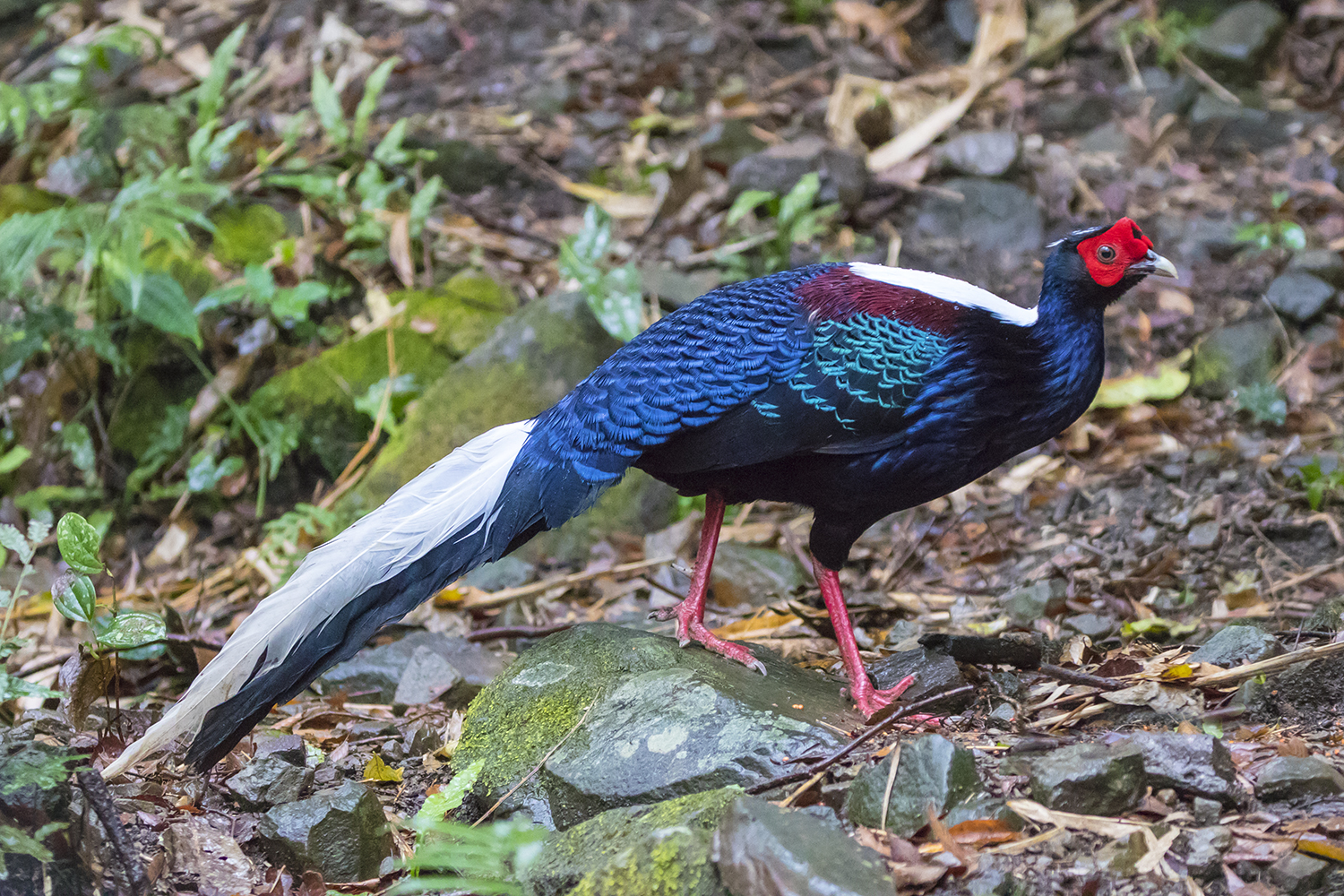

Swinhoe's Pheasant (endemic) - female and the courting male
After some very long wait, we still haven't seen any Taiwan Partridge. We thought the weather was too bad which could be stopping them from visiting. So, by 4:50pm we have nearly given up as light was beginning to dim rapidly. Just before 5pm, Long exclaimed that a pair was coming down the hill from the right! We all tensed up and soon, two rounded birds rolled down the hill in a way only Hill Partridges can. And what a beautiful bird! They dug for food with their feet, all the while seemed very busy. Lights were terrible so my ISO setting was already on 4000 by that time with a very low shutter speed. Luckily with digital photography, I could snap away as much as I wanted to without feeling guilty. Suddenly, sounds from a loud speaker from the village below spooked the pair and they ran back into the cover and didn't return.


Taiwan Partridge (endemic) - glad we didn't miss it!
Mr. Liu came to pick us up by 5:30pm, and we headed back to the resort very satisfied and relieved having seen the last of our main target! After dinner, while having tea with Mr. Liu, he looked outside the door and saw that a Northern Boobook was perched on the wire! He quickly grabbed his torch but the bird flew away before we could get any shots. Mr. Liu reassured us that it will be back again, and sure enough in half an hour it was back! This time were were ready and we got some pretty wonderful closeup view of this owl which made this already awesome day even better.

Northern Boobook - actually the first time I have seen this species at night...
To be continued...


