Sunday, 15 November 2015

Quiet day at Long Valley

This autumn have been one of the worst for Long Valley, where the paddy fields are usually good for various species of Buntings from Crested, Rustic, Japanese Yellow, Pallas's Reed and Pine (We had our first last year), we only had four species to this point (Yellow-breasted, Little, Chestnut-eared and Black-headed). And it's not been very exciting in other department either...It's not been absolutely birdless, but nothing exciting had turned up at Long Valley this season. But this doesn't stop me from trying, as I always hope to find something interesting at Long Valley, and my faith for this site have not yet faded! So, out I was again hoping to find something interesting.


The weather was very nice and pleasant, if not even a little bit on the warm side. First up was anything but interesting, a Common Snipe. Hardly a rare sight, but it's still nice to see it out in the open. Black-winged Stilts were feeding along their usual spots. A fearless Black-collared Starling foraged on the track, it was either completely unbothered by my presence or that it was completely oblivious about my existence. A Plain Prinia provided nice views considering it's not their breeding season, but hardly something to be excited about! (OK I am starting to sound extremely ungrateful)

Common Snipe

Black-winged Stilt

Black-collared Starling

Plain Prinia

I kept scanning flocks of Tree Sparrows for the odd Russet or even House Sparrows, but no luck there. I have always find these "Country" Sparrows more charming then their city cousins, they are much brighter in colour (less dust I suppose) and are usually sharper looking. I did found an odd Sparrow, but it was nothing more then an oddly coloured individual, most likely a leucistic.

Tree Sparrow - the "Country" type

Tree Sparrow - a leucistic individual

Things finally got a little more interesting when a Javan Mongoose ran out from the paddy field. It stopped on the track in front and allowed me to take a few shots before it disappeared into the field again. I wonder if it was looking for snakes or birds at this time of the year. Mongoose are charming little creatures, usually quite curious about their surroundings, you may even see a group of them in the summer playing along road sides.

Javan Mongoose

I found plenty of Painted Snipes today, but all were in really thick cover. This male however thought he got away with it, ducking really low down into the water trying to stay out of sight. It was literally right by my feet, it just shows that they are very confident about their camouflage...At the same pond, a Chestnut-eared Bunting made an appearance, but it was quite skittish and went into cover pretty quickly.

Painted Snipe - you can't see me!
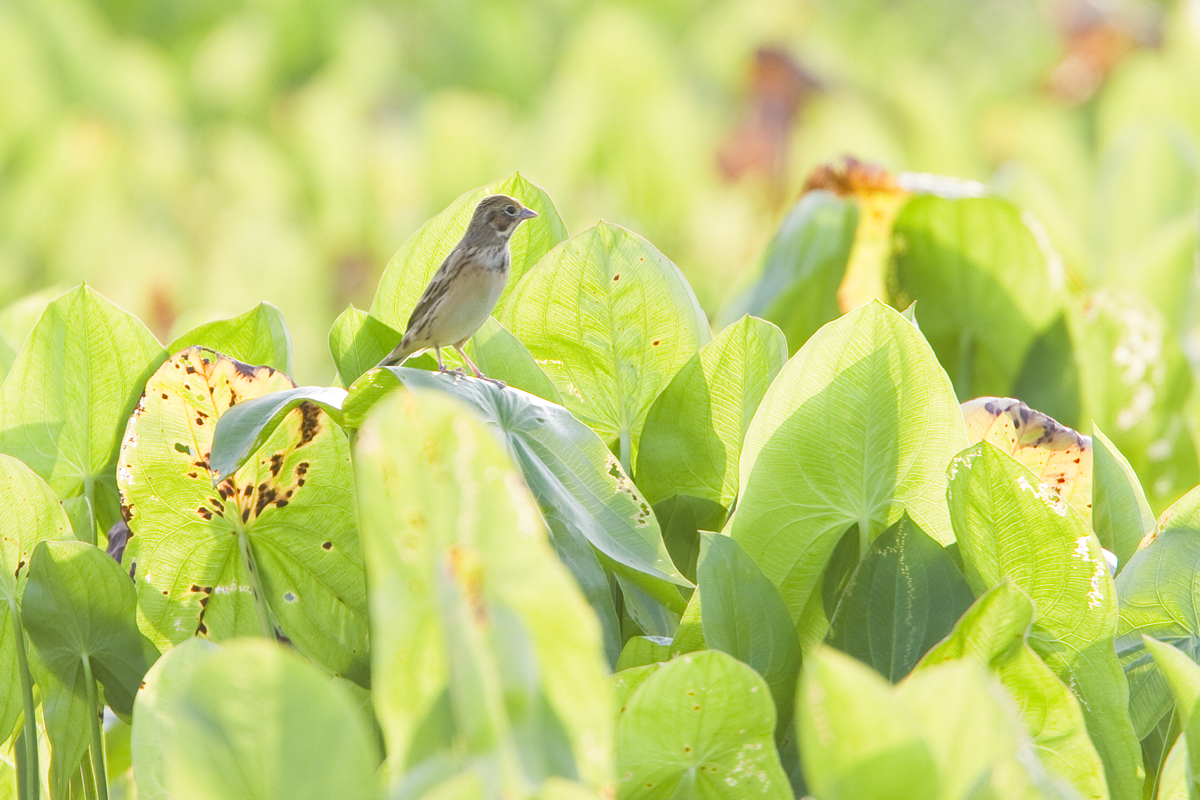
Chestnut-eared Bunting

Not far off a few Yellow-breasted Buntings perched on a Roselle plant. I saw around 10 individuals around Long Valley today, which is not a bad count for this species in a single day, although there would have no doubt be more in earlier years.

Yellow-breasted Bunting - female perched on a Roselle plant

Just as the sun goes down, I spotted another Chestnut-eared Bunting, this time on an overhead wire. Not the best shot but it's one of the better ones I have of this species this year. The cold front haven't brought much from the North, maybe the end of the month will be a little better.

Chestnut-eared Bunting

Monday, 9 November 2015

Pleasant day at Shek Kong Catchment

I had a morning stroll at Shek Kong Catchment. Weather's been lovely these few days, but I really would prefer if it wasn't so warm. It's suppose to be winter already but it sure feels the weather decided to skip that altogether. Never mind, sunny days are good for raptors. I had two Crested Goshawks and a Besra today, though the Besra only flew past quickly. A Crested Serpent Eagle kept circling behind trees so I couldn't get a clear shot of it.

Crested Goshawk

A flock of 30 Chestnut-collared Yuhinas made an appearance, they were exceptionally noisy. They seems to be doing quite well in Hong Kong, with breeding records at KFBG this year. Only a decade ago this species was considered an eruptive winter visitor, it really reminds you how much the forest birds ecology have changed in the last two decades. Mountain Tailorbirds, Pygmy Wren-babblers and Lesser Shortwings were extremely rare, now you can hear them everywhere. Chestnut Bulbuls were also an eruptive species, now common in most forested areas. Mountain Bulbuls were extremely uncommon occasional visitor but is now a resident. Speckled Piculet and Bay Woodpeckers were mega rare birds which have now became residents...well, more the merrier!


Chestnut-collared Yuhina - increasingly common species in Hong Kong

I encountered a bird wave soon after, with Scarlet Minivets, Grey-chinned Minivets, Yellow-cheeked Tit, Cinerous Tit, Japanese White-eyes and a Dark-sided Flycatcher. The female Minivets were particularly showy, coming in quite close to pose for photographs, the males were however a little camera shy. A few were so close that they even drew the attention of a few hikers, all exclaiming at the beauty of such colourful birds. Well, who wouldn't!


Scarlet Minivet - female

Grey-chinned Minivet - also female

The Dark-sided Flycatcher was a bit duller of the bunch, it hawked for insects from it's perch silently, trying it's hardest to stay away from the spotlight. Though not rare, I find this the least common of the three "Grey" Flycatchers in Hong Kong. Asian Browns being the most common, where Grey-streaked Flycatchers are very numerous during migration, I guess the Dark-sided just doesn't like attention much.


I spotted a largish warbler within the bird wave, with quite clean underparts and very sharp upper parts. Pale pinkish legs, single wing-bar with clear crown stripes. No doubt an Eastern Crowned Warbler. It didn't cooperate however and left me with a terrible photographic representation of the species, nevermind that...


The rest of the way was pretty quiet, I had another bird wave with a female Black-naped Monarch but it was gone in a flash. A few sneaky Mountain Tailorbirds, Black-throated Laughingthrushes and Pygmy Wren-babblers kept me entertained. A bird wave containing Silver-eared Mesias and a few Velvet-fronted Nuthatch ended my walk.


Sunday, 8 November 2015

Eurasian Hoopoe - a bird we should be thankful for

Eurasian Hoopoe is a very peculiar species, you can even describe them as eccentric looking. Ornithologists have placed it in a family of it's own (if you don't count Madagascar Hoopoe as a full species), which make them one of a kind. Their behaviour and habit is also strange, though commonly seen in supposedly suitable habitats such as farmland or agricultural land, they frequently visit city parks in Hong Kong, making their appearances in a fairly erratic fashion. They were considered sacred to the ancient Egyptians and King of birds by ancient Greeks, while they are capable of secreting a foul smell that resembles rotten meat when threatened at nest, and their fledgelings are fully capable of self-defence by squirting streams of faeces at intruders...All in all, very strange.

Eurasian Hoopoe - the strange and weird

News of a Hoopoe at Tuen Mun Park traveled fast. Though I have seen Hoopoes in Hong Kong on numerous occasions, I have never photographed one before. Therefore, I thought it was justifiable to pop into the park shortly after a day of volunteer bird guiding at Mai Po (I had Greater Spotted Eagle, Imperial Eagle & Great Bittern). The bird have been stable for a few days, apparently had no fear of men; a bird for the lazy or tired. One can argue that a bird like this provides no challenge for a birdwatcher, and you will be right. But sometimes, you need a bird or two like this to balance things out, especially when you are tired of pishing an invisible Reed Warbler out hoping to get a few seconds of clean look.

Google maps view of Tuen Mun Park

The park itself is situated in the middle of Tuen Mun town, now a fairly built up area filled with malls and residential estates. Like many city parks, the Tuen Mun Park provides a bit of green for the residents here. However, many "Mainland Singers" have taken hold in this nice park, where karaoke singing fills the air with out of tune mandarin songs. They were indeed annoying, and while we were there their songs echoes throughout the park...

View of Tuen Mun Park overlooking the new V City residential complex (me in the foreground)

It didn't take long for us to find the bird and the 20 other photographers who were surrounding it. I quickly grabbed a few shots, and the bird put on quite a show. Posing and stretching for as long as everyone wanted, it probably did enjoy the celebrity treatment, considering it will never get this much attention if it's up in North West China where they are abundant.


Eurasian Hoopoe - performing

Although this bird have been stable, nobody should take it for granted. After five minutes of a wonderful show, the bird decided it have had enough of the attention, after a final stretch it simply flew over everyone's head and out of sight. If me and my Dad have been five minutes late, we would have missed the bird for today. So, be thankful when you have a bird in your view finder, because there won't always be a bird there for you to look at. The whole event from walking to the park, finding the bird and to us leaving the park with wonderful photographs took a mere 25 minutes. That's efficient birdwatching for you!

Eurasian Hoopoe - one final stretch before it flew

Postscript: It is to my knowledge that birds like this caused many disputes and controversies in whether people should "twitch" or extensively photograph, it is arguable that the crowd could cause the bird to feed less due to disturbance and may affect it's survival during harsh times after a long migration. I myself keep to a guideline of "short visits" for such showy birds, one reason being there's no point to stay a whole day surrounding the bird as you can take good photographs straight away (plus I don't like the crowd so much), second reason being to keep the disturbance to the minimum. Similar tactics were used by me for the Siberian Thrush at Shing Mun a few years back, I was only there for 15 minutes to take a few photographs and left. So, short and brief is probably the best for both men and bird. No doubt this subject will continue to be controversial in Hong Kong birding scene in the near future.